
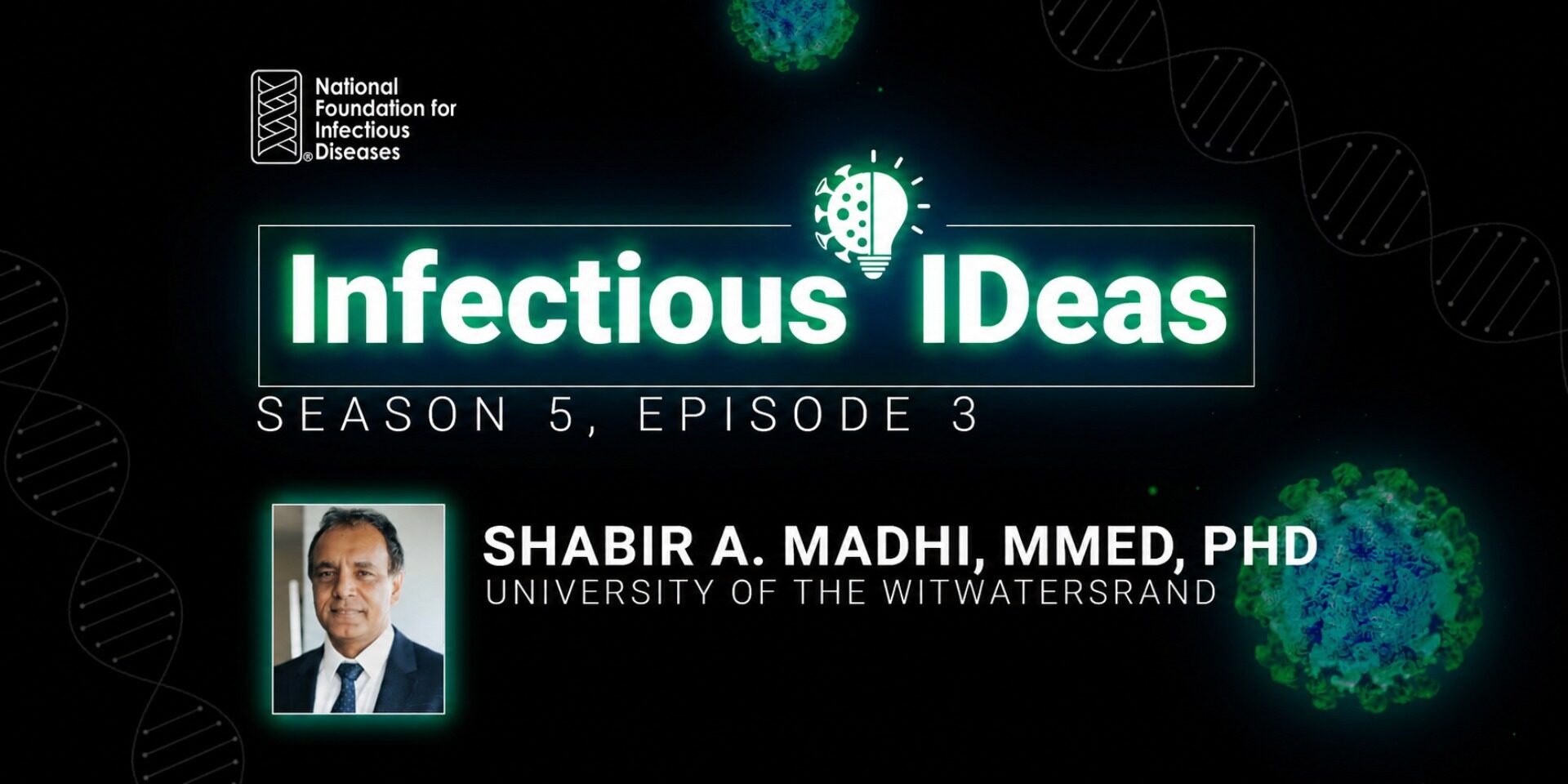
Season 5, Episode 3: What can African scientists teach us about the power of vaccines, the threat of misinformation, and the need to build scientific capacity around the world? In this episode of Infectious IDeas, NFID CEO Rebecca Alvania, PhD, MA, MPH, and NFID Medical Director Robert H. Hopkins, Jr., MD, talk with Shabir A. Madhi, MMed, PhD, professor of vaccinology at the University of the Witwatersrand in Johannesburg, South Africa, and recipient of the 2026 NFID Maxwell Finland Award for Scientific Achievement.
Madhi reflects on how caring for children during the HIV epidemic shaped his career in vaccinology and shares discoveries that changed our understanding of the relationship between viral and bacterial infections. He also discusses the growing threats of vaccine misinformation and antimicrobial resistance, persistent inequities in access to lifesaving vaccines, and why investing in African scientists, research infrastructure, and local vaccine development is critical to the future of global health.
Listen on Apple
Listen on Spotify
Transcript
Alvania
Welcome to the NFID podcast, Infectious IDeas. This is Rebecca Alvania, NFID CEO, and with me is my co-host, NFID Medical Director Dr. Bob Hopkins.
Hopkins
It’s great to be here, Rebecca.
Alvania
Today we’re joined by one of the world’s leading vaccinologists and pediatric infectious disease experts, Professor Shabir Madhi of the University of the Witwatersrand in Johannesburg, South Africa. His groundbreaking research has transformed our understanding of vaccines to prevent pneumococcal disease, rotavirus, influenza, COVID-19, and respiratory syncytial virus or RSV, particularly among children and pregnant women. His work has informed immunization policy around the world and has helped save countless lives.
In recognition of his extraordinary scientific achievements and global leadership in infectious diseases, the National Foundation for Infectious Diseases will honor him with the 2026 Maxwell Finland Award for Scientific Achievement. Professor Madhi, thank you so much for joining us.
Madhi
Thank you for having me, Rebecca.
Alvania
Let’s start at the beginning. You have said that your journey into infectious diseases and vaccinology was somewhat unexpected. Can you talk about the experiences that inspired your career and led you to vaccine research?
Madhi
Rebecca, I did my pediatric residency in the early 1990s, and that residency also coincided with the transition of South Africa from apartheid rule into a democracy, and that’s important because the type of opportunities that became available to me certainly wouldn’t have existed before 1994 when we had our first democratic elections, for a number of reasons, including that scientists in South Africa were very much sidelined during the apartheid days because of the boycott of academia as well as more general disinvestment in South Africa.
During the course of my pediatric training as a specialist, politicians in South Africa unfortunately allowed HIV to run rampant. And my experience as a trainee was that, without exaggerating, 40% of children who were being hospitalized were children living with HIV, despite them constituting less than 2% of all children who were born. And what was really sad was that there were very little treatment options for the management of children with HIV. The mortality rate, the case fatality risk of those children was close to 50-60%. The chances of a child leaving a hospital alive, if they were living with HIV, was close to one in two, which was devastating. Over and above these children dying from opportunistic infections such as tuberculosis, pneumocystis, many of these children also ended up dying from diseases for which vaccines had already been developed, or for which vaccines were in the pipeline. And one of those vaccines that was experimental at that stage was the pneumococcal conjugate vaccine.
So, my training coincided with several different factors, and I was fortuitous in the opportunity that presented itself almost immediately after I graduated to get involved as a clinician scientist in vaccine research.
Hopkins
I reflect on those days. I trained right around the same time you did in the United States. HIV had an incredible impact on my development as a physician, and I can’t even conceive of how difficult it was with the much more difficult situation with HIV and children in Africa. How did caring for children during that time shape your perspective on medicine and on the power of vaccines to improve public health?
Madhi
It was somewhat demoralizing because we simply didn’t have many options [for care] available to us. But my experience in terms of the impact of vaccines, in terms of improving the chances of survival in children, but also in terms of the impact on the pressures that hospitals and healthcare services faced, was something which really convinced me that the way to go in terms of protecting lives, in terms of securing healthcare services itself, was really through prevention, and vaccines certainly have had a massive role.
When we talk of HIV, a leading bacterial cause of hospitalization for children, it was because of the pneumococcus. Children were being admitted with pneumococcal pneumonia, with pneumococcal meningitis. South Africa has a very strong legacy of research with pneumococcus. It actually dates back to the early 1900s when the first vaccine trials on pneumococcus were done in the mines. After we conducted that first study of pneumococcal conjugal vaccine, which included children living with HIV, we saw that we had a tool available, even in the absence of antiretrovirals, that was able to protect babies from being hospitalized for pneumonia, from reducing risk for meningitis. It made one stand up and recognize that there is something that we could offer these children. We might not be able to get them through into adulthood, but we can at least reduce their suffering in those first few years of life.
Alvania
When you look back on your research career and advances that you’ve made, are there scientific discoveries that were most unexpected or most impactful that you could talk about?
Madhi
For me, one of the most exciting discoveries was a discovery which came into being because I didn’t listen to my supervisor—Keith Klugman, who’s based in the US now at the Gates Foundation. He offered me this opportunity of being the lead on the phase 3 pneumococcal vaccine trial. I went to him and I said, what I’d also been interested in as a pediatrician was to investigate children for respiratory viruses, to see what road respiratory viruses had in terms of the contribution to children being hospitalized for pneumonia. And Keith Klugman, being a microbiologist, thought I was wasting my time. He couldn’t understand in a study where we’re looking at how a pneumococcal vaccine protects against pneumonia, why we should bother looking for respiratory viruses. But this was underpinned by me being interrogated as a resident, when one of the consultants asked me what causes a child to be hospitalized for pneumonia. I gave him the differential diagnosis of bacteria and viruses, and his response to me was, I was speaking complete nonsense. He said that all pneumonia cases, of course, started off with viruses.
So, he seeded this idea, the thought that perhaps if we can prevent bacterial pneumonia or pneumococcal pneumonia, we could actually reduce the risk of viral-associated pneumonia hospitalization. And one of the findings of our vaccine trial was that children that received the pneumococcal vaccine were less likely to be hospitalized for viral-associated pneumonia, including RSV, influenza, and human metapneumovirus. So, it was really a striking finding.
And in the early 1990s, there were very few people that really latched onto this concept that the pathogenesis leading to severe bacterial pneumonia was actually underpinned by viral-associated infections, which brings about dysregulation in terms of the innate immune system in the lung, and also increases risk of acquisition of pneumococcus, the density of pneumococcal colonization. That is a finding which I found stunning, and one which has I believe gotten us to rethink our understanding of the pathogenesis of pneumonia in children. Subsequent to that, we showed the converse, where mothers who were vaccinated with the influenza vaccine, their babies were at lower risk of being hospitalized for all-cause pneumonia, where influenza virus was not identified, suggesting that we were preventing bacterial infection by protecting them against a viral infection. More recently with the RSV vaccine, some stunning data that has recently been published, where it’s been shown that children that receive the long-acting RSV monoclonal antibody, they have a 30% lower risk of developing invasive pneumococcal disease in the six months following receiving the long-acting monoclonal antibody. So [this is] something which I was really proud to be a part of in terms of unmasking this nexus of viral infections and pneumococcal infection.
Alvania
We’d like to take a quick break from infectious ideas to talk about the important work of the National Foundation for Infectious Diseases. NFID remains dedicated to providing trusted, evidence-based information to protect public health and empower individuals to make good decisions about their health. But we can’t do it alone. Your support helps us address misinformation by sharing reliable resources to keep individuals, families, and communities safe from preventable diseases. Visit nfid.org/donate to make a difference today. Together, we can ensure everyone has access to the facts they need to stay healthy.
Hopkins
The interplay between viruses, bacteria, and the immune system continues to fascinate me, and will obviously give us plenty of challenges through the rest of our careers and beyond. As we recognize the challenges we face today, both in the US and globally, what do you see as the greatest threats and the greatest opportunities in infectious diseases over these next coming decades?
Madhi
One of the greatest threats we face is the impact that misinformation and disinformation can have, especially in the vaccine space. If we don’t regain public confidence and trust in vaccines, we risk a reversal of the tremendous gains that have been achieved over the past five decades. And that was an important lesson during COVID 19, especially as clinician scientists, we don’t have the luxury of sitting in our labs, in our hospitals, in our clinics, and doing this great work without becoming advocates for the findings to be implemented into our policy and for us to follow through on it.
For me, perhaps the biggest risk that we face, and certainly from a low-middle-income country perspective, is the under-recognized threat that antimicrobial resistance presents. And I say under-recognized because it is a global area of concern, but it’s only more recently that we’ve come to really understand the impact that it is having on under-five childhood deaths in low-income countries. There’s a program known as the Child Health and Mortality Prevention Surveillance Program, which for the first time does post-mortem sampling of children that have died. And what we find in the neonatal period is that almost 50%, one out of every two neonates that die in African countries, are dying because of an infectious cause, and predominantly because of hospital-acquired, multi-drug resistant bacteria. So, if we can’t get on top of protecting children and reducing the risk of infectious diseases from antimicrobial-resistant bacteria, we’re not going to make any further advancements to achieve the sustainable development goal of reducing neonatal mortality to about 12 per 1000. So, antimicrobial resistance presents perhaps one of the biggest challenges.
But opportunities, on the other hand, are just massive. At no other time in history are we presented with the type of technology that’s becoming available at a breakneck speed because of generative AI, the potential to be able to discover new drugs, new vaccines in a really condensed period of time is second to none. And it’s about how we’re able to leverage on those opportunities, and then once leveraging out those opportunities and once being successful in terms of developing those new vaccines and new drugs.
The biggest challenge that we have faced throughout my career and before is the issue of affordability, and it is an issue of timeliness of access to those life-saving discoveries where it’s needed most. And unfortunately, in the field of infectious diseases, often where it’s needed most happens to be in low-income countries. Often those are the places where there’s a 10- to 20-year lag between when these life-saving interventions become available in high-income countries compared to when they become available to populations that are most burdened by infectious diseases.
Alvania
Shabir, you’ve spoken so passionately about this issue—the importance of access to vaccines—and as you say, despite remarkable scientific advances and the promise of future advances, millions of people still lack access to these life-saving immunizations. So, what do you think needs to change for us to be able to meaningfully close that gap around access?
Madhi
It requires a multi-pronged approach. But for me, one of the biggest changes that needs to happen is that governments of low-income countries need to take on more political and financial responsibility. I don’t think they can shirk away from that responsibility. The dependencies on donors and philanthropists (which is most welcome, because at the end of the day, it is the children that are benefiting) unfortunately, it doesn’t lend itself to sustainability and doesn’t lend itself to ensuring that we actually have the architecture in place which allows children to benefit, sooner rather than later, from these interventions. African governments, as well as governments of other low-income countries, need to take on much greater responsibility in terms of funding. And that shift is coming about.
In addition, there has to be a growth of expertise on the African continent [for them] to take ownership of determining what the research agenda and priorities should be, and for them then to be able to actually leverage technology, which can be indigenized to ensure that they themselves are the ones that are involved in discovery, and they themselves are involved eventually in local manufacturing of those interventions—the vaccines and the drugs—so that they are accessible at a much earlier stage.
There obviously is the issue of price tiering or market shaping, which Gavi has been really successful in doing, and that market shaping needs to continue because that is going to lend itself to issues around affordability. There’s a number of loose ends. But where we also need to up the game on the African continent is that many of our programs are somewhat siloed. As an example, in the vaccine space, we don’t have the type of programs that are necessary to develop an end-to-end vaccine ecosystem. Obviously, have great training programs for immunologists, microbiologists, and genomics. But it’s not integrated. So, we need to change the type of training and the platform that we use for the training to ensure that we develop the skill sets that are required for Africa to be able to become equal partners, at least competitive when it comes to end-to-end manufacturing and discovery of vaccines.
Hopkins
You’ve emphasized that Africa should not simply participate in research but help define the global research agenda. How has the scientific landscape in Africa evolved during your career, and what gives you hope for the future?
Madhi
The changes have been remarkable. When I got inaugurated as a professor of vaccinology (at a university ranked as a top university on the continent, the University of Witwatersrand), when the vice chancellor introduced me as professor of vaccinology, he actually asked me, “What does that stand for?” And this wasn’t very long ago, because the concept of a vaccinologist simply didn’t exist on the continent even 15 years ago. So that has changed completely. You go across any African country, people are training as vaccinologists. There has been this recognition that we need a different skill set, and I think that is a change that’s taking place across the continent. There’s huge amount of investment taking place.
During COVID-19, it was a great example of just how competitive African scientists could be in terms of responding to a pandemic. Much of the work around genomics, around clinical development of vaccines, the first reports on the genes which were invasive to neutralizing antibody, all came out largely from the south, from South Africa and neighboring countries.
So, I think the COVID pandemic showed that we do have the capacity, capability, and expertise on the African continent. Now the big challenge is to make sure that expertise expands beyond one single country, and really becomes pervasive throughout a continent. That is what is going to contribute to us eventually having that skill set that’s required for Africa to participate end-to-end in terms of vaccine and drug discovery, as well as other technologies in the medical space.
Opportunities are arising. There’s more of a political commitment, and there’s more of a recognition that Africa’s external dependencies pose a massive health security risk to the continent. The only way that we can mitigate it is to invest in people, and that investment will eventually provide returns in terms of ensuring that we have health security on the continent that is owned and developed by scientists on the continent.
Alvania
Shabir, you’ve had a remarkable career already, and many impactful years to come. But when you think about your legacy—the work that you’ve done—what do you hope will be most remembered?
Madhi
What I would like to be remembered for is capacity development, especially in the field of vaccinology. It’s something I feel very passionate about. When I started my research career, there was very little investment in capacity development, especially of clinician scientists in the African continent. The opportunities that I’ve been offered have also allowed me the opportunity to grow talent, especially clinician scientists. The biggest issue about leaving a legacy is that there are many others who are going to be able to rise above the levels that I’ve achieved, and for me, that will really be a testament to success.
Hopkins
Thank you, Shabir. We’ve been talking today with Professor Shabir Madhi, an internationally recognized leader in vaccinology, whose research has transformed the prevention of infectious diseases, and whose commitment to scientific excellence, equity, and mentorship continues to shape the future of global health. Congratulations again on being named the 2026 recipient of the NFID Maxwell Finland Award for Scientific Achievement.
Thanks again for joining us, Professor Madhi, and thanks to all for listening to this episode of Infectious IDeas, a podcast presented by the National Foundation for Infectious Diseases, where leading experts join us for thought-provoking conversations that lead to infectious ideas. Be sure to subscribe on Apple Podcasts, Spotify, or wherever you listen to your favorite podcasts. And if you’d like more information about NFID, visit nfid.org. Until next time, stay safe, stay healthy, and get vaccinated.