
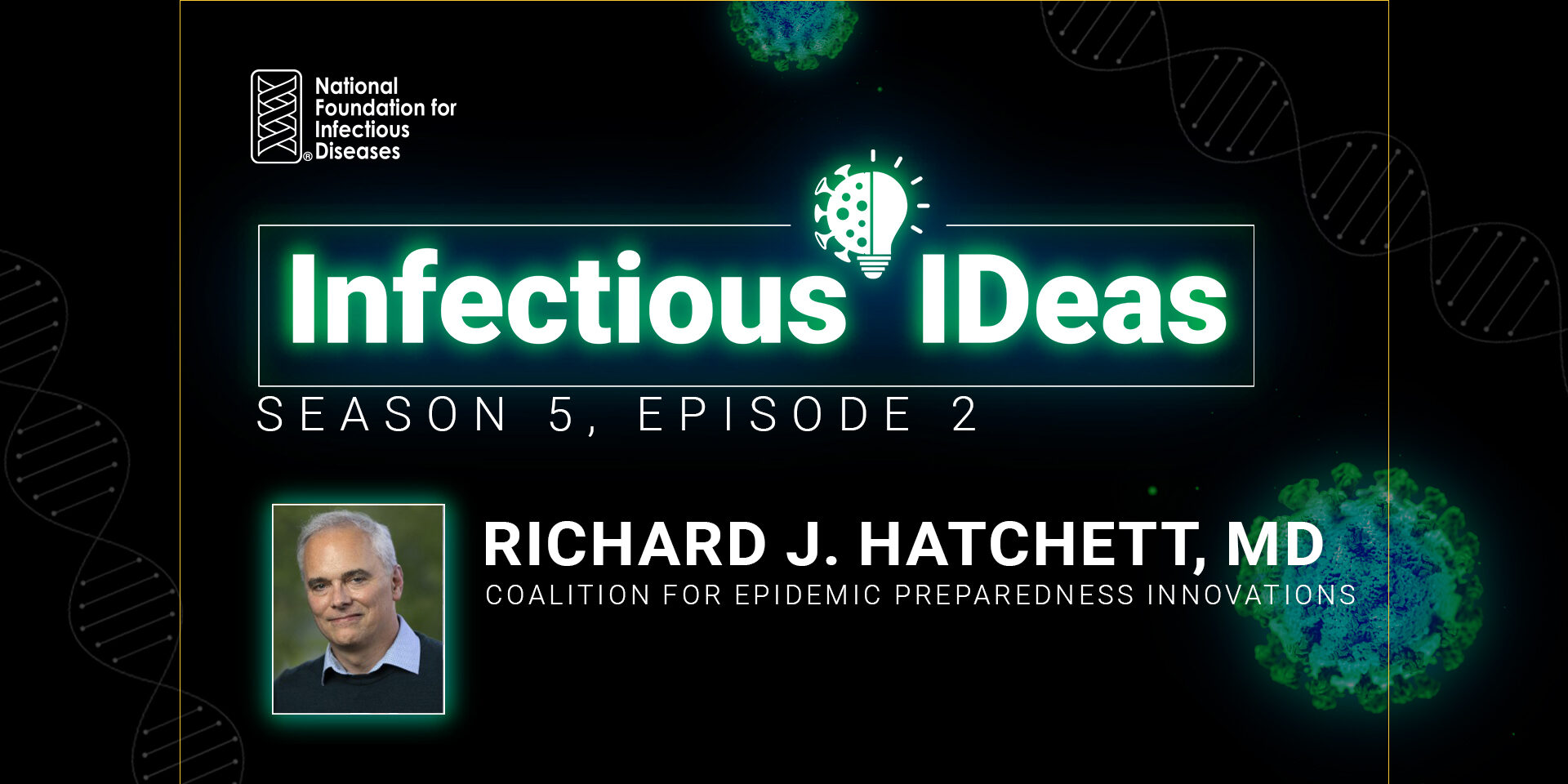
Season 5, Episode 2: What will it take to better prepare the world for the next pandemic, and why are vaccine equity and disease surveillance critical to that effort? In this episode of the Infectious IDeas podcast, NFID CEO Rebecca Alvania, PhD, MA, MPH, and NFID Medical Director Robert H. Hopkins, Jr., MD, have a candid conversation with Richard J. Hatchett, MD, CEO of the Coalition for Epidemic Preparedness Innovations (CEPI) and recipient of the 2026 NFID Jimmy and Rosalynn Carter Humanitarian Award. He shares his thoughts on the 100 Days Mission, the lessons of Ebola epidemic, and why he sees pandemic preparedness as a matter of conscience as much as science.
Hatchett traces an unlikely path from a medical residency during the early years of the AIDS epidemic, to Ebola fieldwork in Gabon, to volunteering at Ground Zero after September 11 — the same instinct, he says, that later led him to help found CEPI in response to the West African Ebola epidemic. He discusses the current Bundibugyo virus outbreak in the Democratic Republic of the Congo and Uganda, the chronic underfunding of disease surveillance, and why he considers CEPI’s commitment to equitable vaccine access more significant than any of his own technical contributions.
Listen on Apple
Listen on Spotify
Transcript
Alvania
Today we’re joined by Dr. Richard Hatchett, CEO of the Coalition for Epidemic Preparedness Innovations, who’s dedicated his career to advancing global preparedness against emerging infectious diseases and accelerating vaccine development in times of crisis.
Widely respected for his leadership during the COVID-19 pandemic, colleagues credit him with maintaining a steadfast commitment to global equity and ensuring that life-saving vaccines reached people around the world, including those in low-income countries. Throughout his career, from senior leadership roles under Presidents George W. Bush and Barack Obama, to his work responding to Ebola and COVID-19, he’s emphasized the importance of collaboration, urgency, and compassion in public health.
In recognition of his extraordinary leadership and his belief that science must ultimately serve people and protect communities everywhere, the National Foundation for Infectious Diseases will honor him with the 2026 Jimmy and Rosalynn Carter Humanitarian Award in October 2026. Richard, thank you so much for joining us.
Hatchett
Thank you, Rebecca. Thank you, Bob. It’s a pleasure to be here, and I’m just fantastically honored to be receiving the Jimmy and Rosalyn Carter Humanitarian Award.
Alvania
Let’s start at the beginning of your career. What first sparked your interest in global health and emerging infectious diseases?
Hatchett
So, I’m trying to remember exactly when I first started getting interested in infectious diseases, I finished medical school in 1995 and then went to complete my residency in internal medicine at Cornell 1995 to 1998, and it was the tail end of medical school and the beginning of my residency, that books like Richard Preston’s The Hot Zone and particularly Laurie Garrett’s The Coming Plague were being published. I think those were out of the mid ’90s. Certainly, I also would say that I was probably the last generation of physicians to train before highly active antiretroviral therapy was available for HIV, and so we actually had an entire floor at New York Hospital dedicated to inpatient AIDS care at a time when we still had dreadfully ill people, and actually that was my first year of my internship, and that floor closed down before I completed my residency because HAART (highly active antiretroviral) therapy came out and just radically transformed everything.
That was what got me interested in infectious diseases. While I was a in my third year of residency, I was able to actually go and work on an Ebola project in northeast Gabon an incredibly transformative experience for a variety of reasons. I had planned to do a fellowship at Yale in infectious diseases to continue working on that project, and some personal issues came up that I had to withdraw from that fellowship. I took a position at the Memorial Sloan Kettering, working in the urgent care center, and was revectoring towards oncology when I got sucked back into public health preparedness as part of my personal involvement in responding to the events of September the 11th.
Hopkins
Our life does lead us to changes, doesn’t it? So, as the founding CEO of CEPI, you championed the 100 Days Mission to compress vaccine development timelines. Can you tell us a bit about that initiative and the role it plays in galvanizing governments, industry, and scientific institutions to prepare for pandemic threats?
Hatchett
Sure, Bob. Thank you. So, the 100 Days Mission, as an aspiration, as a goal, really emerged from our observations at CEPI during the pandemic of all the different innovations that were implemented on the fly by different actors pursuing different projects to accelerate the development, particularly of vaccines. As an organization, Coalition for Epidemic Preparedness Innovations was set up in January of 2017. It really kicked off with the goal of developing vaccines against epidemic and pandemic diseases, and we very quickly, in I think in 2018, elevated equitable access into our mission statement, along with the developing vaccines against epidemic diseases, and ensuring that the populations that needed them had access to them.
In COVID, we responded very rapidly. I believe we were the first organization globally to fund vaccine development for what became COVID vaccines. We announced our first agreement on January 23, 2020, and one of one of our early awardees was Moderna, who had been involved in developing a MERS vaccine with the NIAID vaccine research center, and they were able to pivot very rapidly. They effectively had a coronavirus vaccine design. were able to pivot very rapidly to produce a SARS-CoV-2 vaccine design And that’s just one example. Over the course of the pandemic, we ended up supporting 14 different groups that were supporting vaccine development. We got to the end of the pandemic, and everyone marveled at the speed with which vaccines were developed. In the West, the first vaccines became available, I believe, on December 8, if I’m remembering correctly, 2020, in the UK, which was 326 days after the release of the viral sequences on January 10 and 11th, so about 11 months. So, the vaccines came online very rapidly, but more people died globally in 2021 than perished in 2020.
So even though we were delivering vaccines in record time, it wasn’t fast enough, and the excess mortality figures for COVID were really dreadful. Around 20 million people, 7 or 8 million documented COVID deaths, and of course the impact on society was tremendous. The education learning loss from closed schools was dreadful, and so we, looking at our experience, looking at how quickly people had innovated in different ways and independently to accelerate vaccine development, we said, “Is it possible to drastically compress vaccine development timelines? And what would it take? What would we need to be able to engineer the ability to produce safe and effective vaccines within 100 days of identifying a new pathogen? That was the genesis of the 100 Days Mission, and it became a central pillar, but it was really a transformation of the organization and our sense of its mission and what its ambitions should be.
Alvania
You served as the acting director of U.S. Biomedical Advanced Research and Development Authority (BARDA). You talked a few moments ago about your past role with Ebola response. What lessons from your past do you feel are relevant today?
Hatchett
We just announced our first agreements to develop Bundibugyo vaccines. And it dawned on me that CEPI was established effectively almost 10 years ago, and we’re right back where we started. The West African Ebola epidemic was the trigger for the creation of CEPI. The problem in West Africa was that we had a large Ebola outbreak, and we weren’t prepared from a vaccine perspective, and here we are in 2026 with a large Bundibugyo outbreak, and we don’t have a Bundibugyo vaccine in advanced development that we can rush into the field. So, in a sense, we’ve come full circle, but I think also we’re about to see how much the systems have improved and how much progress we’ve made relative to 2014-2015.
I think one big lesson from 2014-2015 is actually signified by the organization that I lead, which is there was a widespread recognition after the epidemic that the global health community needed an organization whose job was to develop vaccines against epidemic diseases that could have massive public health consequences, but where commercial markets were not driving the development of needed public health products, and there were obviously a variety of reasons for that. But the principal one was that these diseases principally occur in lower- and middle-income countries. They’re episodic. The demand is intense when you have an outbreak, and almost non-existent when you don’t. And so, one of the key lessons was to create an organization to address that problem, and that organization became CEPI.
I guess the final thing that I would say in 2014-2015 was really a marker along the way, but the experience of the last several decades, of course, going back to SARS, thinking about the global dissemination of H5N1, then the H1N1 pandemic in 2009, then Ebola, then Zika, then the Ebola epidemic in Eastern DRC, and then COVID. There’s this drumbeat of incidents at different scales against a backdrop of continuous smaller outbreaks that I think has finally impressed itself upon at least this generation of political leaders that this is an enduring problem that needs systemic institutional commitments. Often you will hear people talking about treating something like CEPI as an insurance mechanism: it’s more like medical insurance every year you’re going to need to draw on your medical insurance. Some years more than others, but you actually have insurance because you have an ongoing, continual need. It’s not like life insurance, it only pays out once at the end of a long period of time, and at a point when you don’t care about it anymore. I think we’re still in the process of switching mindsets about public health preparedness and viewing it not as a development problem or not as a global health problem but viewing it as a constitutive security problem for the 21st century.
Alvania
We’d like to take a quick break from Infectious IDeas to talk about the important work of the National Foundation for Infectious Diseases. NFID remains dedicated to providing trusted, evidence-based information to protect public health and empower individuals to make good decisions about their health, but we can’t do it alone. Your support helps us address misinformation by sharing reliable resources to keep individuals, families, and communities safe from preventable diseases. Visit nfid.org/donate to make a difference today. Together, we can ensure everyone has access to the facts they need to stay healthy.
Hopkins
What do you see as the most urgent public health issue that’s not getting enough attention? But I think you may have actually answered that question with preparedness writ large. Are there other urgent issues that we don’t attend to enough?
Hatchett
The investment in public health institutions and in disease surveillance capabilities seems to be a really easy one for governments to downgrade when they’re facing their sort of day-to-day quotidian funding challenges and budget challenges. But surveillance is critically important to enabling effective response. And I think we’re seeing that in Eastern DRC now, where there was a delayed detection of Bundibugyo, and so now we’ve got a much larger outbreak to try to grapple with in a very contested and complex region. The most important asset that you have in an epidemic context is time, and the only way to actually create time is with better surveillance and detection. If you detect earlier, you have the longer lead time to develop countermeasures if you need to. And if you detect earlier, you also have a better opportunity of containment, ideally stopping the outbreak altogether, or at least reducing its transmission and geographic diffusion, both of which create time. So, in my mind, investments in surveillance capability, detection capability, and the public health systems that are required to enable that is absolutely critical and criminally underfunded.
Alvania
When you were talking about your early career, it sounds like you were pointed towards infectious disease, pointed away for a while, then came back to it. So, when you talk to early career scientists today, the next generation, especially those interested in infectious disease, wondering where the field is going, what advice would you give them?
Hatchett
Let me finish the story. I stopped a little abruptly in terms of how I got back to infectious disease, and in New York on September the 11th, I was running the emergency room, the urgent care center at Memorial Sloan Kettering Cancer Center, and we spent the day shocked by what had happened, but trying to set up for what we felt was going to be an influx of patients who never arrived, but you either walked home or you perished for the most part. There was a call for medical volunteers to come to Chelsea Piers, and then, and ideally, one assumed to be organized into some kind of support for the search and rescue workers. I went down. There was no organization at all. There were just people clustering around. Anyway, a group of us self-assembled, found our way down to Ground Zero, and by happenstance, just really by chance, I ended up being asked to take over for what ultimately became the main triage area for medical support to search and rescue workers in Stuyvesant High School, which was a few blocks north of Ground Zero.
We did it by hook and by crook. The disaster medical assistance teams ultimately took over on Friday morning, but we managed. We didn’t have any formal system for dealing with volunteers, checking credentials. We didn’t bring any supplies with us. They just were showing up in 18-wheeler trucks at the back door of the high school, and the area when I came in, it was a few beds, cots, and a few boxes of supplies. It ended up being a four-story field hospital, really almost by that evening, but just with hundreds of volunteers, and so was really impressed by the quality of the volunteers. Healthcare workers are independent and smart. They’re used to taking responsibility for their actions, inspired and inspiring. And so I had the presence of mind to collect the names of people that were running what became the various specialty areas within the field hospital that we were operating effectively, and over the next few weeks, working with them and with a small grant from the Sloan Foundation, put together a proposal to create something that we were calling and thinking it was for New York City, the civilian medical reserve. And we kept talking to people. We kept getting bumped upstairs, and pretty soon we were talking to folks at the White House. And President Bush ended up embracing our proposal to create what became the Medical Reserve Corps program. And I was scheduled to go and begin my oncology fellowship at Duke in July of 2002, and I was invited to come to Washington to help set up this program in the office of the Surgeon General. Duke was very gracious and let me defer my fellowship for a year. I ultimately finished the fellowship and then went straight back to Washington. So that’s my own personal story, where I made a very drastic and sudden change of direction in a career that would have probably followed a relatively conventional pathway towards academic oncology because it felt like the right thing to do, and because I was motivated to do it.
And so, my advice to young people, either medical people or people coming through public health degrees, is don’t be afraid to take risks and follow the things that you’re passionate about, and you will do well, and all will be taken care of too. I’ve followed that trajectory ever since, and I’ve never regretted the path that I have taken, but it was not a planned path, and there was no road in front of me. It’s like the Machado poem. You create the path by walking, and I would certainly encourage others to follow.
Hopkins
Richard, sometimes we can see the light in front of us, and sometimes we have to go around that mountain in front of us. Could you help our audience get to know you a little better? What’s something that people might be surprised to learn about you?
Hatchett
As an oncologist, that I’m fantastically unqualified to be running a vaccine organization would be one thing. I do like to tease my infectious disease colleagues and say all the good immunology comes from oncology, but I’ve learned an awful lot on the job.
Another thing that may surprise some people is my background is in the humanities. I was an English major as an undergraduate and have always found the insights that I have gained from literature to be profoundly useful in navigating the complexities of a professional career and the relationships that have to be managed. You have to be able to see things through the eyes of others to understand what they value, what they’re seeking, and that that’s an incredibly valuable skill. The other thing that I think the humanities provided me a foundation for, and that medical training actually I think cultivated in a real way was I was always attentive to trying to have a good bedside manner and communicating clearly and effectively to your patient in the way that the patient needed, not in the way that I might choose or want or need
Alvania
When you look back on your career, you’ve had some really amazing accomplishments from the work that you described after 911, founding of CEPI. What do you hope that people remember most?
Hatchett
In the role that I’m in, it’s easy to be mistaken just for being a technocrat, as somebody who’s essentially got a technical job, and you do or don’t do the technical aspects of the work well. What has animated CEPI’s success is the moral purpose behind it, the moral ambition. And I think one of the smartest things that we did during my tenure was to elevate the equitable access mission actually into the mission statement, That’s become foundational to CEPI’s identity. We have a gigantic ambition to accelerate the development of vaccines, and we have an even larger ambition to make sure that those vaccines are allocated fairly and moved to the people that need them first and foremost. And that’s created an environment in CEPI that I think the CEPI staff find really inspiring. They are very mission-oriented, and the extent to which I have been able to foster that and to create an organization with a moral purpose is, in my mind, much more significant than my rather puny direct technical contributions.
Hopkins
Richard, if you weren’t focused on epidemic preparedness, what else could you see yourself doing?
Hatchett
Possibly in my relatively near future, as I get towards the end of my career, I’m not quite there yet, but I would love to sit in my garden and write poetry, go back to the humanities. I’ve had a fascinating and rewarding career, and very keenly interested in literature, humanities, religion, history, and I’d like to think that my efforts to maintain my intellectual breadth have informed what I’ve been able to do in my career, and I look forward to getting back to that at some point.
Alvania
I look forward to reading your book of poetry at some point. Before we sign off, I want to give you the same opportunity that we give to all of our guests. If you could bust one myth in public health, what myth would you most like to bust?
Hatchett
I would like to bust the myth that epidemic and pandemic diseases are black swans, and I think they are a product of the environment and the world that we have created for ourselves and need to be viewed as such. I’ve used the term that they’re a security problem. They’re such a fundamental problem forcing them to compete with other critical public health priorities like HIV, TB, malaria, other diseases of poverty, chronic diseases. To say that there’s a pot that you have to address today’s health problems and address the problem of epidemic and pandemic disease is category mistake, I think. And I would love to let the public health community and the medical community get on with providing universal healthcare and providing people with good preventive care and helping them live longer, healthier lives, and have societies as a whole recognize that they have to address these episodic infectious disease threats systemically and through institutional commitments and through sustained political will, and I’ve been trying to do that for most of my career. I haven’t succeeded yet, unfortunately.
Hopkins
If we succeeded too early, we’d never get anything accomplished in the long run. We’ve been talking today with Dr. Richard Hatchett, an international leader in pandemic preparedness and global health equity.
Thanks again for joining us, Richard, and thanks to all of you listening to this episode of Infectious IDeas, a podcast presented by the National Foundation for Infectious Diseases, where leading experts, join us for thought-provoking conversations that lead to infectious ideas. Be sure to subscribe to the podcast on Apple, Spotify, or wherever you listen to your favorite podcasts. And if you’d like more information about NFID, be sure to visit us online at nfid.org. Until next time, stay safe, stay healthy, and get vaccinated.