 Special thanks to vaccinologist Angela R. Branche, MD, associate professor of medicine at the University of Rochester, for this guest blog post on the rigorous standards for vaccine clinical trials.
Leaders at US federal agencies have been calling for new policies to bring the “gold standard” back to clinical trials of vaccines (by which they mean using placebos). The problem is the implication that recent vaccine development has relied on clinical trial methods that fall short of the highest standards of design and conduct. In reality, vaccine trials have adhered to the gold standard for years.
Many vaccines are initially tested in randomized trials with placebo or comparison groups. But once a safe, effective vaccine is available, using a placebo would be unethical, as it leaves participants unprotected. Imagine testing a new blood pressure medication by withholding standard treatment from some patients who need it.
So let me, a vaccinologist who has participated in many clinical trials, shed some light on this issue. Vaccine trial design begins with understanding the disease. Clinician-scientists who treat patients and study epidemiology help identify who needs protection and why, and often lead trial design, working with the National Institutes of Health, Centers for Disease Control and Prevention (CDC), and industry partners to ensure that the best science is being done to develop vaccines that protect those most at risk.
Preclinical Trials in Labs and Animals
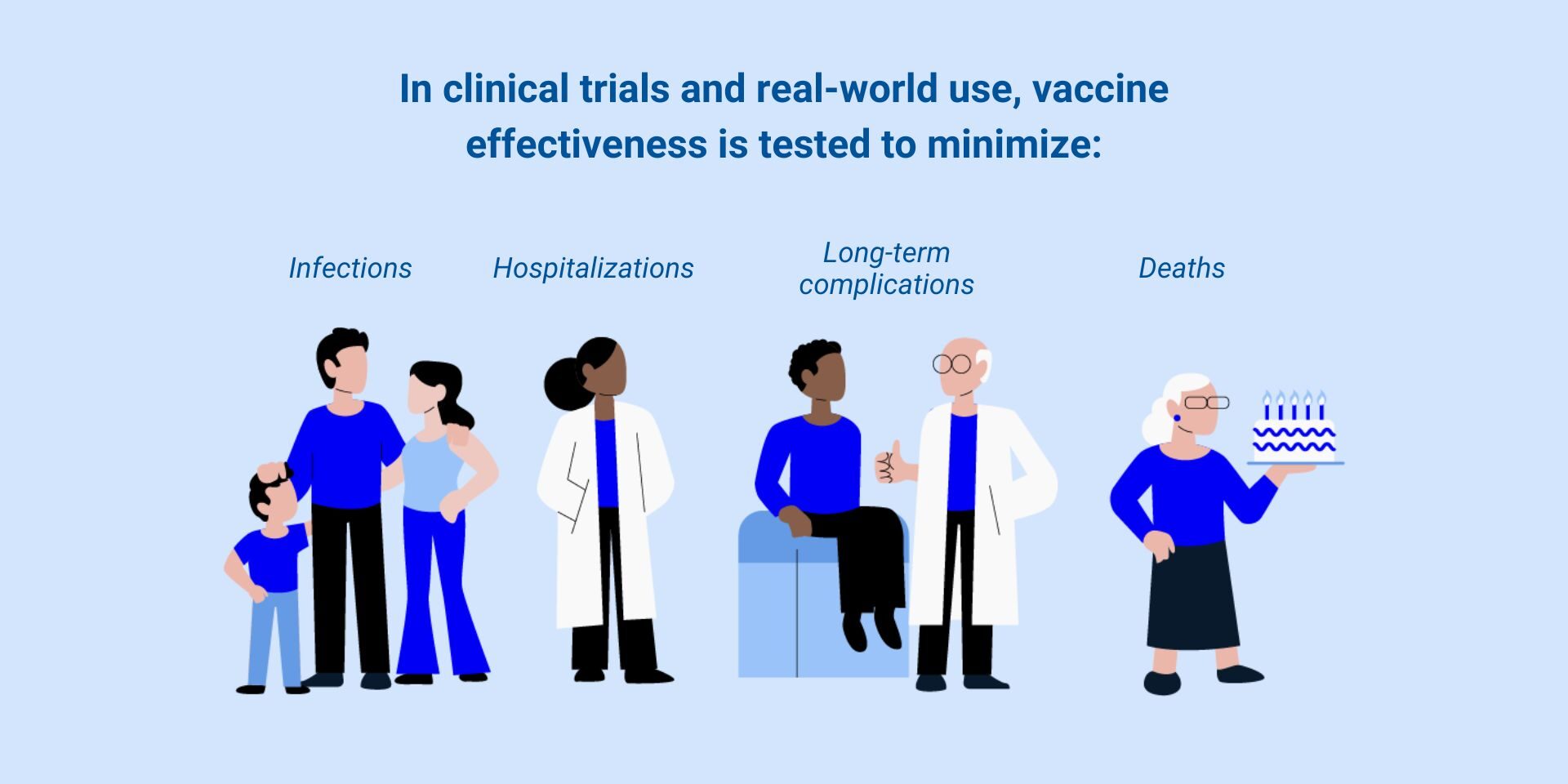
After decades of study to define disease burden and at-risk populations, trial design focuses on endpoints—whether the vaccine prevents death, hospitalization, or symptomatic infection, and whether it can reduce transmission. At the same time, preclinical studies in animal models (mice, ferrets, nonhuman primates) assess safety, dosing, and immune response. These data are compiled into an application for the Food and Drug Administration (FDA), which may approve, reject, or request changes to the study. Similar processes apply when vaccines are updated or tested for new populations such as children.
3 Phases of Clinical Trials
Once a vaccine has received FDA approval to be tested in humans, clinical trials proceed in 3 phases. The trial phase must fit the question, the vaccine, the disease, and the population.
Phase 1 first-in-human trials are entirely about safety. We enroll about 100 healthy participants, who are followed intensely and have a battery of safety tests and immunity assessments performed. All expected and unexpected adverse events–complaints, symptoms, and new conditions–are stringently reviewed by a safety monitoring committee who can halt the trial at any time. Phase 1 trials are the most interesting scientifically but also the most stressful because they come with the knowledge that we are asking people to assume unknown risk for the good of humanity. I truly appreciate all our study participants, but phase 1 volunteers have my deepest respect and admiration.
Phase 2 trials typically enroll 500-1,000 participants with 2 goals: to continue evaluating safety and to better understand the immune response. This phase also expands beyond healthy young adults to include stable adults who are at risk for the disease. If results show the vaccine is safe and generates a strong immune response—and sometimes early signs of effectiveness—the vaccine moves forward. Many vaccine candidates fail in this stage.
Phase 3 trials are much larger, often enrolling 20,000-30,000 participants. This phase evaluates how well the vaccine prevents disease, based on specific outcomes such as death, hospitalization, or symptomatic illness of a defined severity. In some cases, the goal is to show an improved immune response compared with an earlier version of the vaccine.
This brings me to an important point: Phase 3 trials often have multiple arms, with participants randomly assigned to receive 1 of 2 or more vaccines or, in some cases, a placebo. Critical to the phase 3 trial design is an important concept known as “equipoise.” In lay terms, that means there must be genuine uncertainty about which option is better. Without that uncertainty, assigning participants to a less effective option would be unethical. For this reason, placebo-controlled trials are not always the “gold standard,” particularly when an effective vaccine already exists.
A few years ago, I helped conduct a clinical trial of a new antiviral drug in which hospitalized patients were randomly assigned to receive drug or placebo in a blinded fashion. After demonstrating that the drug improved clinical outcomes, we unblinded the treatment assignment. Half of 20 participants had received placebo. Of the 4 heartbreaking deaths at our site, all 4 were placebo recipients.
Though not a coincidence, that’s the nature of clinical research—you don’t know something will work until it does. However, the converse is also true. You can’t design a placebo-controlled trial if you already know the vaccine is better. That upholds the most important principle of medicine and the true “gold standard,” to do no harm.
Join NFID for the Annual Conference on Vaccinology Research (ACVR), June 15–17, 2026, for expert discussions on innovation in vaccine science and critical issues in implementation and communication. ACVR is virtual and free to attend.
To join the conversation and get the latest news on infectious diseases:
- Like and follow NFID on social media
- Listen and subscribe to the Infectious IDeas podcast
- Subscribe to receive future NFID Updates