
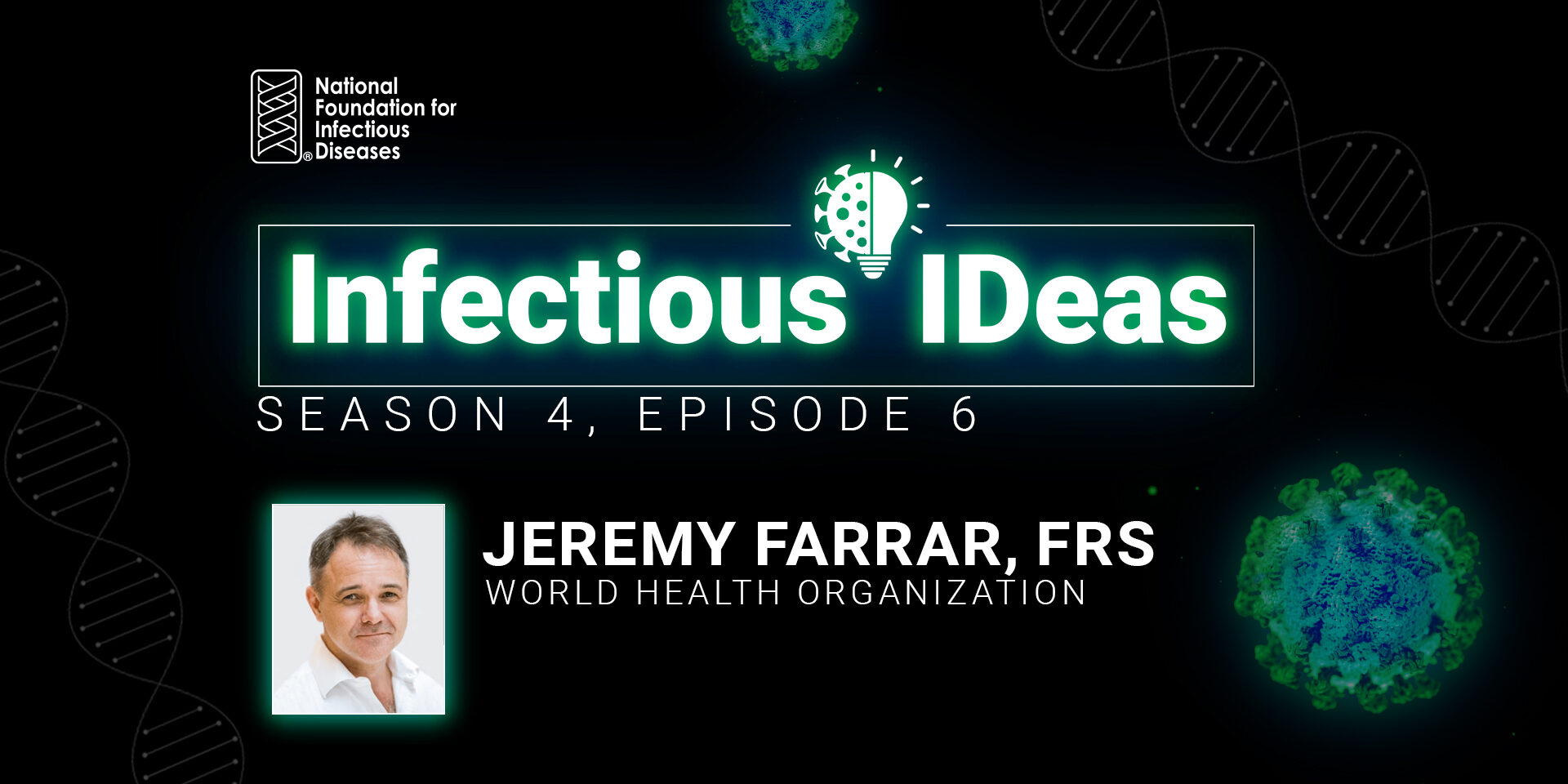
Season 4, Episode 6: Jeremy Farrar, FRS, of the World Health Organization (WHO), joins new hosts Rebecca Alvania, PhD, MA, MPH, and Robert H. Hopkins, Jr., MD, for an insightful conversation on the power of science, the importance of community, and the urgent need for trust and collaboration in an increasingly polarized world. Drawing on decades of experience—from the early days of HIV/AIDS to pandemic preparedness, vaccine development, and global health leadership—Dr. Farrar shares personal lessons on failure, leadership under pressure, and why optimism, humility, and inclusion are essential to shaping the future of public health.
A physician-scientist, international health leader, and advocate, Dr. Farrar’s work has spanned HIV/AIDS, research on avian influenza, and leadership at Wellcome, where he helped guide the global response to the COVID-19 pandemic. He now serves as assistant director-general of health promotion and disease prevention and control at WHO, providing leadership on infectious and noncommunicable diseases, health promotion, food safety, and the health impacts of environmental change. In 2019, NFID honored him with the Jimmy and Rosalynn Carter Humanitarian Award in recognition of his outstanding contributions to global public health.
Listen on Apple
Listen on Spotify
Transcript
Alvania:
Welcome to the NFID podcast, Infectious IDeas. This is Rebecca Alvania, NFID CEO, and with me is my co-host, NFID Medical Director, Dr. Bob Hopkins.
Hopkins:
Hey, happy to be here, Rebecca.
Alvania:
Our guest today is Dr. Jeremy Farrar. He serves as the World Health Organization’s Assistant Director-General of health promotion and disease prevention and control. Many of you know him for his groundbreaking work on infectious diseases with pandemic potential. He’s also held major leadership roles, including director of the Welcome Trust and co-founder of Coalition for Epidemic Preparedness Innovations (CEPI), the global effort to speed vaccine development and ensure access worldwide. In 2019, NFID honored him with the Jimmy and Rosalynn Carter Humanitarian Award. It recognized his impact on global public health and his commitment to making the world a more equitable place.
Jeremy, thank you so much for joining us.
Farrar:
Great pleasure.
Alvania:
All right, we’re going to start at the beginning. You began your career working in HIV AIDS. How did those early experiences shape you as a scientist?
Farrar:
That would have been in the late 1980s and of course, that was the time that HIV was becoming known about. And I do remember—I was a medical student, and soon after graduating—just the impact this had. I was working in London at the time, and medical students and doctors had got used to the idea that many things were treatable, and then suddenly you had mostly young individuals coming in. And frankly, there was very little anybody could do. Obviously, we didn’t know what the cause was, and that was devastating, actually.
But also on the positive side, as a result of great science and great public health, some solutions did start to come, and I pay huge tribute to the community who were then known to be living with HIV, because the role they played in pushing science and pushing public health was, I think, absolutely groundbreaking. And I’m not sure the establishment would have got there quite the way it did without that pressure from the community.
So, three lessons: one, is the devastating impact of something new, in this case, HIV. Secondly, the incredible power of science. And thirdly, the critical importance of communities being part of engaging and owning the solutions.
Alvania:
What led you to global public health after that experience?
Farrar:
That was a very protracted course because I originally trained as a neurologist. I was fascinated by neurology. I had an amazing—and I think this has an influence on all of us—an amazing mentor, Charles Warlow in Edinburgh, where I was working at the time, and then John Newsom-Davis in Oxford, where I did my PhD. And so, I wanted to go into neurology but then realized actually neurology perhaps wasn’t quite for me. And so I moved to Vietnam but always kept a great interest in neurology. I’ve always been fascinated by interfaces. And unfortunately, many people in clinical medicine and public health sometimes feel a little bit frightened about neurology. It seems very complicated. And being able to bring some knowledge, of neurology in the brain, and then learning, having to learn, in Vietnam a lot about infectious diseases. Of course, a lot of infectious diseases affect the brain and to bring interfaces together, something Charles Warlow taught me, people that work across disciplines, but have the respect of multiple disciplines, I think can really move something forward, and I hope I contributed there to an understanding of the brain. But then I learned about malaria, HIV, tuberculosis, typhoid, dengue, and was able to then apply it in how that affected the brain, as well as then learning all about infectious diseases. So, it was a protracted route into infectious diseases and global public health.
Hopkins:
Our journeys are often quite different. They don’t follow a straight path, do they? So, as you think back, Jeremy, what stands out as your proudest achievement?
Farrar:
There’s a very good point about linear, how careers develop, and I just hope, going forward to the next generation, that we retain that same flexibility. I do worry that we’re pushing people into vertical silos too early, and we’re not encouraging enough people to perhaps experiment across different disciplines. So, I do hope that flexibility remains.
On a personal level. I think my proudest moment—obviously family and other issues at home—but I think my proudest moment was to have been an international sports person as a teenager still counts pretty high. And secondly, my proudest moment, having failed initially, was to get into medical school, because everything flows from that.
But if you’re not fortunate enough, privileged enough, lucky enough to get in the first place, it’s tricky. I’m not going to make any excuses. It was my own fault. But getting in the second time around, I still remember the moment of walking into the door of the medical school. I still have a tingle in my spine thinking about that.
Hopkins:
I had an interesting experience around that time in my life. After applying to medical school, I had some doubts, and I withdrew my application, and was told by a dean of a medical school, “You’ll never be a doctor.” And at graduation from medical school, I went back up to this gentleman who’d been the dean that told me you’ll never be a doctor, and said, just wanted to remind you of this. And he said, “Oh, I’d never say anything like that.”
Farrar:
Yeah. And I think mentorship and sponsorship and support is so important. We still remember the people that had big influences on our lives, both good and negative. None of us is perfect. We’re all good and bad, and yet we learn from everybody, and I think we, perhaps, just acknowledge those people that had critical roles to play, either by encouraging you when you were down, got into medical school and somebody picked you up and said, yeah, why don’t you give it another go, criticizing that he got things wrong, but in a constructive way, and opening doors. And we all owe what we do to those who have supported us.
Hopkins:
We stand on the shoulders of giants, one way or the other.
Farrar:
Yeah, yeah, both good and bad.
Alvania:
I really love it when accomplished people talk about the moments when they did not accomplish something. So, I’m going to join the party and say that I did not get into graduate school the first time I applied. But I’m also intrigued by your international sports backgrounds. Can you tell us a little bit more about that?
Farrar:
The excuse of why I didn’t get into medical school the first time around was because the grades were not high enough, because I was playing too much sport. And I know this may not translate so well across the Atlantic, but there’s a sport in Europe and Australia called rugby, and there’s another one called cricket, and there’s another one called field hockey, none of which really resonate in North America. So, apologies for that, baseball, and I don’t know how you play it. I was never really good enough to make it as a sports person, but I wish I had been a sports person. It was the great love of my life and always team sports. I never got particularly attracted to individual sports. I can watch them, I admire them, I respect how they do it, and the discipline and training that goes with it, but I only wanted to play team sports.
Alvania:
So, Bob asked you about your proudest accomplishment. What would you say, looking back, would have been the toughest challenge that you faced?
Farrar:
The toughest challenge came in Vietnam, which would have been around a very difficult situation with an individual who had a long family history and tragically in the end, ended up taking their life. And that had a profound influence on me about how it was handled, how I handled it, how the collective handled it. And that was a very difficult moment.
I think that the other one I would remember is whilst at Welcome, at the time of the Black Lives Matter movement, we commissioned at Wellcome a piece of work on institutional racism. I think it was the right thing to do. I think it made us look very critically at ourselves. But the review came out and was extremely difficult to deal with on a personal level, on an institutional level. But I think it’s critical that all organizations have the capacity to look at themselves critically, and that can be very tough.
But if you want to move in the right direction, stand for the values you stand for. I think it’s not so much on the science side, dealing with the coming of H5N1 and then the pandemic, but I think the ones that get inside you are perhaps a little bit more personal, and which really counter your values and principles and what you think you stand for, but you may not stand for. On a personal and professional level, that’s tough to deal with.
Hopkins:
So, Jeremy, I thoroughly enjoyed your book, Spike. You wrote, If citizens reject the scientific method, which is at the heart of everything we do, and which has given us the means to exit this pandemic, then our future struggles against climate change, water scarcity, and diseases will be that much tougher. We need to be more open and engaging about what we do, how the scientific process works, and how scientific research and analysis influences policymaking and how its benefits can be shared fairly.
It seems to me, this is about as prescient a statement as one could make about the world today. How do we turn the tide back?
Farrar:
I’m more optimistic than maybe I put there, in the sense that I think humanity throughout history often looks over a precipice and sometimes makes terrible decisions and goes down a terrible path. I’m the son of, for instance, an individual who spent years as a prisoner of war in the Second World War. And the 20th century, as all centuries, had some pretty dark, terrible moments, as this century will.
But in the end, I think humanity, after going through a lot of bad options, ends up usually taking the better options. And I think science broadly defined—and the evidence base and the framing of asking and challenging questions at the heart of the scientific methodology and the impact it has—will turn this current challenging moment.
I don’t think we’re going back. I’ve worked through this in 2025 and it felt like working through grief. We had a consensus over many decades of scientific progress, development, building a more equitable world. Not perfect, it never will be, but building a more equitable world. The scientific method that is at the heart of that—and culture and diversity—is currently being challenged, as it inevitably was going to be, because humanity challenges itself. I’ve had to work through a sense of loss, that the consensus through my professional career is now being challenged.
What I think is critical is that we acknowledge that grief. We work through it ourselves, because we cannot be creative when we’re feeling like we’ve lost something, and then play a critical role in redefining that future. I don’t believe we’re going back to something of 5, 10, 15 years ago, we’re going to something new, and that’s what we have to define. I think science can play a critical role, along with culture.
I think science and scientists need to engage and not accept that it’s top-down, patronizing, which it can be, elitist. Science must remain accessible to everybody and open to everybody, or become open to everybody. If science is increasingly done by a small sector of society, those who go to the best schools and have the most privilege, then you can’t expect the rest of society to trust it. So, we lost that sense of meritocracy and openness to everybody, and I think we need to redefine that.
Hopkins:
So how do you convince governments, funders, and the public to maintain and invest in those collaborations?
Farrar:
I think the only way is through making lives better at the end of the day. I do worry that we’ve become a little bit abstract in how we frame things. I’m not a climate scientist, but I firmly believe that climate and health should be together. But I think we’ve often framed the climate crisis as something that might affect your children or grandchildren in 2050 or at the turn of the century.
We need to bring it back to how this is impacting your lives today, negatively, and how we need to change it, because at the moment, it feels like it’s going to happen in 20-30 years. Persuading people to do something for 20-30 years is very difficult. This is where social science and behavioral science become so critical to understand this.
We need to move from what I might call the elite abstract concepts into, What does this mean to people next Tuesday? What does it mean to me next Tuesday, my sister, my brother, whatever it might be, and become more concrete about the impacts and the positive things we can do rather than the negative. You’re going to have to stop flying, you’re going to have to stop using your car, whatever, and make the case for the concrete improvement of lives. Because, ultimately, I think science is about improving lives.
Alvania:
We’d like to take a quick break from infectious ideas to talk about the important work of the National Foundation for Infectious Diseases. NFID remains dedicated to providing trusted evidence-based information to protect public health and empower individuals to make good decisions about their health. But we can’t do it alone. Your support helps us address misinformation by sharing reliable resources to keep individuals, families, and communities safe from preventable diseases. Visit nfid.org/donate to make a difference today. Together, we can ensure everyone has access to the facts they need to stay healthy.
Alvania:
You mentioned that we’re in a period where consensus is being challenged, but that we’re not moving backwards necessarily. We’re moving forward. So, when you look ahead a decade, what would you see as the biggest obstacle for global public health?
Farrar:
I cannot see how the current polarization geopolitically is going to help us when most of the great challenges in the 21st century are not nationally defined. Whether we talk about climate change, gender issues, pandemics, antimicrobial resistance (AMR), or mental health, these are not issues that are going to be defined by some arbitrary border on a map. And yet, I fear that the current polarization is pulling that collective just at the time when the challenges are truly global in a way that perhaps 50-100 years ago they were not. It’s going to be a huge challenge to overcome. I don’t think it’s impossible, but I think it’s going to be a huge challenge to our collective ability to respond to what—unlike the 20th or 19th century—are more global agendas, irrespective of boundaries on a map.
Hopkins:
Despite the many challenges in public health today, what gives you hope for the future, Jeremy?
Farrar:
Oh, everything, almost everything. It’s been particularly true for me personally in the last year or so. When you lose hope or a sense of optimism, it’s really difficult—for me, it’s almost impossible—to be creative. And I actually do think that we go through in history these moments of challenge and questioning whether we’re doing the right things. It’s awful at the time, but I don’t think it’s a bad thing. We have to collectively respond across whatever influence or actions we can take.
If you look at almost every area of science, I would argue there’s progress. We’re worried about the influence of information technology, digital, and data, and there are real concerns for mental health and other issues. But on the whole, the trend is hugely positive. I grew up knowing people with polio. I was vaccinated against smallpox. A generation ago, somebody living to the age of 70 in many countries was just unheard of, and the number of families were big because so many lost their babies or mothers in childbirth. So, the progress is staggering. I just think we’ve taken some of that for granted, and we’ve become complacent that progress will always be true, whatever we do. We have to go back with humility and revisit that.
Hopkins:
Perhaps we’re too much on the doom-saying and not enough on the positive.
Farrar:
It’s been a tough year for everybody, I’m sure for you. It’s certainly been a tough year here at the World Health Organization, with us downsizing, but I do feel very optimistic about the future. I just think we’ve got challenges now, and we’re all privileged to be in a position of some degree of leadership, whatever roles we can play. Leadership really matters when things are tough.
When you’re all agreeing with each other, leadership matters, but when things are tough, and questioned and challenged as they should be, then leadership really matters. At the moment, with the disruption going on and the challenges we face, that’s when leadership really matters.
I don’t think progress is linear. Progress goes through a series of moments, which humanity has to grasp. The actions and decisions you make in those moments really make a difference. I don’t usually quote Lenin, but I think he said there are decades when nothing seems to happen, and then there are weeks when decades seem to happen. I think he was absolutely right, and we’re in one of those moments now. Leaders should not look back on them in history and say, that was a moment, and we missed it.
Now is the time to lean into the challenges, with optimism, with your values, with your commitment to the future and everything you stand for. And this is when I think it really matters.
Alvania:
You mentioned digital briefly, and that’s certainly an area where you can see the positive connections it has allowed, but it also allows misconceptions to swirl across the globe. If there were one myth or misperception about science or public health that you could dispel once and for all, what would it be?
Farrar:
Firstly, that science is not for me, or culture is not for me. There’s no entry point for me. It’s not accessible. It’s not affecting my life, and I’m not engaged with it. It’s not part of me.
Ultimately, when any sector, organization, or agency moves away from that connectivity with the very people we serve, then it loses its legitimacy. Therefore, making sure that science remains meritocratic, that it is open and accessible to everybody, that it addresses people’s concerns for tomorrow morning, as well as their concerns in a decade. And it remains diverse, and we don’t increasingly push it into a smaller number of places, for a smaller number of people, addressing a smaller number of people’s challenges.
Hopkins:
Jeremy, what is something people would be surprised to learn about you?
Farrar:
I used to hide the fact that I didn’t get into medical school the first time around. I’m now quite proud of that fact, but for many years, I thought I shouldn’t acknowledge that.
I don’t play a musical instrument. I cannot read music. I can’t understand how you could write classical music, popular music, jazz, or whatever music, and put it all together. It just looks like a completely different mind. But, gee, I love it.
We all need ‘me time.’ I still get it through sport, but I increasingly actually get it through walking. The ability to turn off, the ability to not have your phone on, the ability to just lose yourself is hugely helpful in terms of well-being.
Hopkins:
You still pick up the cricket bat every once in a while?
Farrar:
Yeah, I stopped playing rugby only about 10-12 years ago. Yeah, I still play cricket.
Alvania:
I think I might know the answer to this question. But if you hadn’t gotten into medical school, what career could you imagine yourself pursuing?
Farrar:
I think, probably a sports person, if I could have been. I was never really good enough. Maybe a teacher. My father was a teacher. My sister was a teacher. I had early inklings of being a diplomat, but then my language skills were so awful that I thought that couldn’t be for me. And I have to say, I hugely respect diplomats. They play an absolutely critical role, but now seeing it more close hand, I don’t think I could be a diplomat, actually. So, I would give that one a miss.
Hopkins:
This has been a wonderful conversation, Jeremy. We appreciate you spending some time with us. We’ve been talking today with Dr. Jeremy Farrar, physician-scientist, international health leader, and advocate. Jeremy, it has been our great pleasure to visit with you today, and I want to thank you again for joining us.
Farrar:
It’s been great pleasure and it’s been great fun, which, if you put those two things together, you don’t go far wrong.
Hopkins:
Absolutely. I also want to thank those listening to this episode of Infectious IDeas, a podcast presented by the National Foundation for Infectious Diseases, where leading experts join us for thought-provoking conversations that lead to infectious ideas. Be sure to subscribe to the podcast on Apple, Spotify, or wherever you listen to your favorite podcasts. And if you’d like more information about NFID, visit us online at nfid.org. Until next time, stay safe, stay healthy, and get vaccinated.