
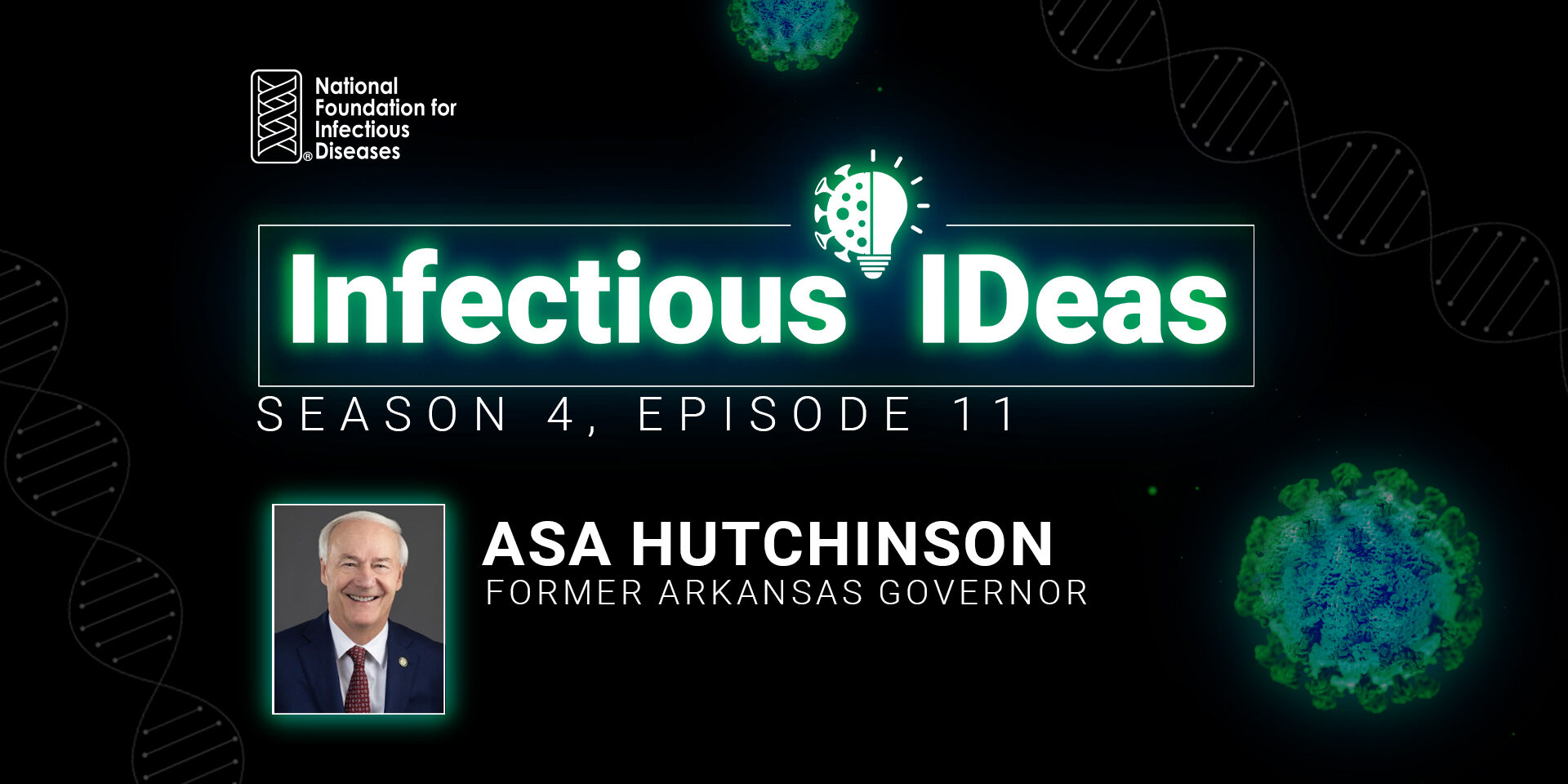
Season 4, Episode 11: What happens when public health becomes politicized? In this episode, hosts Rebecca Alvania, PhD, MA, MPH, and Robert H. Hopkins, Jr., MD, are joined by former Arkansas Governor Asa Hutchinson for a wide-ranging conversation on public health leadership, vaccine confidence, and crisis communication. Drawing on his experience in state and federal governments, including leadership roles during COVID-19 and the SARS outbreak, Hutchinson reflects on how emergency preparedness, public trust, and cultural differences shape public health policy and response.
The discussion explores the growing politicization of vaccines, the challenges of balancing federal guidance with state-level decision-making, and why regional public health collaborations have emerged in response to fractured national policy. Hutchinson also shares lessons learned from leading Arkansas through the pandemic, including the importance of transparent communication, daily public briefings, local medical partnerships, and education over mandates in a state skeptical of government intervention. The episode closes with a candid look at the nation’s current preparedness for future public health emergencies and why declining trust in institutions may be one of the greatest vulnerabilities moving forward.
Listen on Apple
Listen on Spotify
Transcript
Alvania:
Welcome to the NFID podcast, Infectious IDeas. This is Rebecca Alvania, NFID CEO, and with me is my co-host, NFID Medical Director, Dr. Bob Hopkins.
Hopkins:
Good to be here with you, Rebecca.
Alvania:
Today, we’re joined by former Arkansas Governor Asa Hutchinson, a longtime public servant with experience across state and federal government, including leadership roles related to national security and emergency response. Over the course of his career, he’s helped guide policy decisions during complex and fast-moving challenges, including public health crises like COVID-19. He currently serves on the board of advisors for the Vaccine Integrity Project at the University of Minnesota, which is working to evaluate vaccine policy questions through a transparent, independent process. Governor Hutchinson, thank you so much for joining us.
Hutchinson:
Hey, it’s great to be with you today. Thanks for the opportunity.
Alvania:
You’ve had a wide-ranging and impactful career in public service. How did your experiences throughout your career shape the way that you think now about public health preparedness and response?
Hutchinson:
Of course, my background doesn’t fit neatly into the infectious disease world since, by profession, I’m a lawyer. I have practiced law throughout my life. But I’ve had a lot of public roles that have caused me to deal with public health crises. But it all starts out really, when I grew up. In my generation, I’ve had a rural upbringing on a farm outside of Gravette, a small town in northwest Arkansas, and my parents were farmers. At that time, vaccines were a given that was necessary to save lives and to provide healthy opportunities for the next generation. I think about my parents, who were married during the Great Depression, in a time when we didn’t have the vaccines that we have today, and so they understood the risk. And so, it was ingrained into me that this is important and an accepted part of consideration for community health. That helps shape your thinking.
During the Bush administration, I was asked to be part of the leadership team for the newly created Department of Homeland Security. And that’s where you come face-to-face with emergency management and preparedness. We had to deal with the SARS outbreak in 2004, and I learned how to respond in an emergency fashion. All my experiences helped me to be a better governor, and unbeknownst to me, we were going to face a huge public health crisis that we hadn’t seen in 100 years while I was governor, and I was grateful for the experiences of my life that helped set the tone for that time.
Hopkins:
Governor, one issue that’s become increasingly visible is the politicization of vaccination. From your perspective as a former governor, how has that shift affected decision-making at the state level?
Hutchinson:
It’s impacted it dramatically, the politicization of it, the mixed messaging of it. It is not the messaging that I had growing up, where it was a rarity for someone to say I have a religious exemption against vaccinations. It has gradually changed through the years, where there’s been an underground movement of concern about vaccinations. It was something that policymakers had to deal with, but it was a very minor voice, and it was not a national movement. So that’s what has changed, and it happened during COVID, where vaccine skepticism came into play, and it has really expanded beyond that now. The skepticism—which comes from leaders, it comes from mass communication, it comes from social media—all of that has combined to make it a more of a political issue, and that’s problematic. That gives us a greater amount to overcome. I love a lot of what Secretary RFK Jr. has advocated for, in terms of dietary health, but in terms of the vaccine side of things, the raising of skepticism and giving credibility to those who are already somewhat skeptical has created a political dynamic that is much more difficult for policymakers to deal with today.
Alvania:
Over the last year, in response to changes that we’ve seen at the federal agency level, particularly around immunization policy, we’ve seen some regional alliances formed, like the Northeast Public Health Collaborative, which my state of Maryland is a part of. As someone who has worked in both federal and state leadership, what are your views on that regional approach to public health, and specifically immunization policy?
Hutchinson:
It’s not ideal. Ideally, you have a national federal policy that respects the states, but you provide leadership at the national level, and that gives us a consistent approach. The immunization committee of the Centers for Disease Control and Prevention (CDC) has always had extraordinary credibility. And the credibility that they had, the states followed, and it had the respect and the credibility that was needed.
That has been undermined today. There’s a lot of reasons for that undermining, and a lot of different voices that have had a part of it. But that has given rise to the regional partnerships, which really bring cultures that are more common together, and say this is going to be our approach. I think it’s understandable that whenever there is a fractured policy at the federal level, that you have the states step in, they provide innovation. So hats off to the states for filling the gap and recognizing that there is a need for it—not ideal, but it is where we are. I hope someday we can get back to more of a unified viewpoint on public health.
Hopkins:
We continue to see, Governor, outbreaks of vaccine-preventable diseases like measles. When you read about those situations, what stands out to you in terms of how states can respond to falling vaccination rates and outbreaks?
Hutchinson:
I looked up measles just to refresh myself on the vaccination policy in Arkansas, and measles is still a mandated vaccine for our state. But then you see the exceptions to it, and it is for religious exemption, it can be for a health exemption, or that you oppose it for philosophical reasons. Now that is as wide a train as you need to have a problem. But in a culture like Arkansas that opposes mandates and loves freedom, [there is] room for the skeptics to operate. As vaccine skepticism increases, then you’re going to have more requests for those exemptions for philosophical reasons, which is a very low bar to cross. That is the challenge we face.
It comes down to education. During COVID, we did not mandate everybody to take the COVID vaccine, but people wanted it. They were scared to death, particularly those who were vulnerable. But there were still the skeptics who did not want to be told they had to take that, and there wasn’t a mandate. The way I approached it was education, and so I held town hall meetings all across the state of Arkansas, rural communities, urban communities, and I brought the medical community together. It’s not the state telling them what they should have to do, but it is the local health community saying this is important, and they’re more trusted advisors that can fill that role. And so again, it comes down to education efforts, making sure that the message is out there as to the public health benefits from good immunization policies and practices.
Alvania:
We’d like to take a quick break from Infectious IDeas to talk about the important work of the National Foundation for Infectious Diseases. NFID remains dedicated to providing trusted, evidence-based information to protect public health and empower individuals to make good decisions about their health, but we can’t do it alone. Your support helps us address misinformation by sharing reliable resources to keep individuals, families, and communities safe from preventable diseases. Visit nfid.org/donate to make a difference today. Together we can ensure everyone has access to the facts they need to stay healthy.
Alvania:
We know that when public health guidance differs across federal and state levels of government, it can create a lot of confusion. And I really appreciate the perspective that you brought earlier when you said, in response to the regional collaborations, ‘We are where we are, and so it’s great that the states are stepping up.’ In an ideal world, how should our political leaders approach that balance between consistent national direction and local decision-making to advance the entire nation’s health?
Hutchinson:
One, don’t undermine the good work that the CDC does or effective messaging at the national level. Now, if the national message is inconsistent and erratic and not supportive, then you’ve got to fill the gap to a greater extent.
The second part of the equation is recognizing the huge cultural differences that we have in America, state by state, region by region. And if we had another outbreak today of an infectious disease, you’re going to have states taking different approaches. And the reality is that many red states are going to take a more ‘everybody make their own decision’ type approach, blue states are going to have a stronger governmental approach to it. Those are realities, and I think we have to respect the fact that political leaders are going to reflect some of the cultural differences in our country and what is strong in their population.
And there again, Arkansas is one of those red states. Arkansas doesn’t want mandates. We didn’t put mandates in, but we provided the education, we provided the support, the credibility, and the understanding. And so that, to me, is how a red state governor balances the need for good public health policy but also operates within the culture of their state.
In the next pandemic, I think you’ll see the federal role being for response support developing vaccines quickly, testing, but in terms of the actual work in the states, the governors will play a critical role, just as they’ve had in the past.
Hopkins:
Communication obviously plays a critical role in any type of crisis. What lessons have you learned about how to communicate clearly and effectively in those high-pressure situations? Given that leaders often have to make decisions without complete information and make it to people with wide-ranging beliefs and belief systems?
Hutchinson:
Going back to my public career, I was United States Attorney. I laid out the truth, knowing that the public could handle it. After 9/11, people of the country feared the next terrorist attack, and we had a policy, we share information, and we trust America to handle that information. And history has shown that when you tell them the truth, they can handle the truth, and they don’t operate in fear. Going back to Franklin Roosevelt, who had the fireside chats, he shared the gloomy days that we suffered during the Depression and World War II. Instead of creating fear, it gave people confidence. That’s how you have to approach a public health crisis as well.
When the pandemic hit, I knew exactly what we were going to do. Our first COVID case came. We declared an emergency. I held a news conference. I had my medical professionals there, and we started something that went for 200 days. We had daily news conferences and wound up having over 200 of them. The public could see, even though we didn’t know all of the answers, we shared the truth as we saw it, and we knew that they could handle it. They were thriving under that truth, even though it was bad news many days, but they acted with greater confidence because we communicated with them and told them exactly what we knew, and they trusted it.
It was frustrating because at the national level you had some of the truth that you were trying to put out being undermined. So, it was very difficult during that time, but the role of the governors again was critical, and sharing that message day by day with the public was what they needed to hear.
Alvania:
You’ve probably spent a lot of time thinking about state preparedness. So, I’m curious today, where do you think most states would still be vulnerable when it comes to the next public health emergency?
Hutchinson:
The sad thing is that our state of preparedness diminishes the further you get away from the emergency. One, you have different leadership in place that did not have to lead during the last pandemic, and so they’re not aware of the acute anxiety when you didn’t have testing equipment, whenever you did not have vaccines, whenever you’re trying to get a personal protective equipment, and you had to get it from overseas, and whenever you went into your warehouses, it was not fresh, it was out of date. They didn’t have to live that experience, even though it was just six years ago. Time does fly.
Our preparedness is better now than it was pre-COVID. We’ve got better supply chains, we’ve got better plans in place. Our public health community is better prepared, our national stockpile is at a higher level, and we’ve learned some lessons about how quickly you have to respond to develop the testing. It has to be reliable. Also, invoking the National Defense Production Act to help produce the vaccine. These are all experiences that really worked well during COVID and gave us the record-setting development of a vaccine. Those are great success stories, so we’re in a better position now.
But the negative side is we’ve got greater cultural differences, greater distrust of government than we’ve had before, and that distrust will not serve us well if we have another public health crisis.
Hopkins:
Governor, thank you again for joining us today. I have a final rapid-fire question for you. The harder things are the shorter ones. What one word would you use to describe the state of public health today in 2026?
Hutchinson:
I’d use the word uncertainty. It is the confidence level that’s uncertain. It is the skepticism over vaccines that is uncertain and has left people with an uncertain approach.
But I also want to express certainty in terms of the confidence we have in our public health leaders. They really showcased themselves during the last pandemic, they showed how important their mission is, and the work that they do day in and day out, and that confidence level and that certainty is greater now than it’s ever been.
Hopkins:
We’ve been talking today with former Governor Asa Hutchinson about leadership, preparedness, and the future of public health. I want to thank you again for joining us, Governor Hutchinson, and thanks to all listening to this episode of Infectious IDeas, a podcast presented by the National Foundation for Infectious Diseases, where leading experts join us for thought-provoking conversations that lead to infectious ideas. Be sure to subscribe to the podcast on Apple, Spotify, or wherever you listen to your favorite podcasts. And if you’d like more information about NFID, please be sure to visit us at nfid.org. Until next time, stay safe, stay healthy, and get vaccinated.