
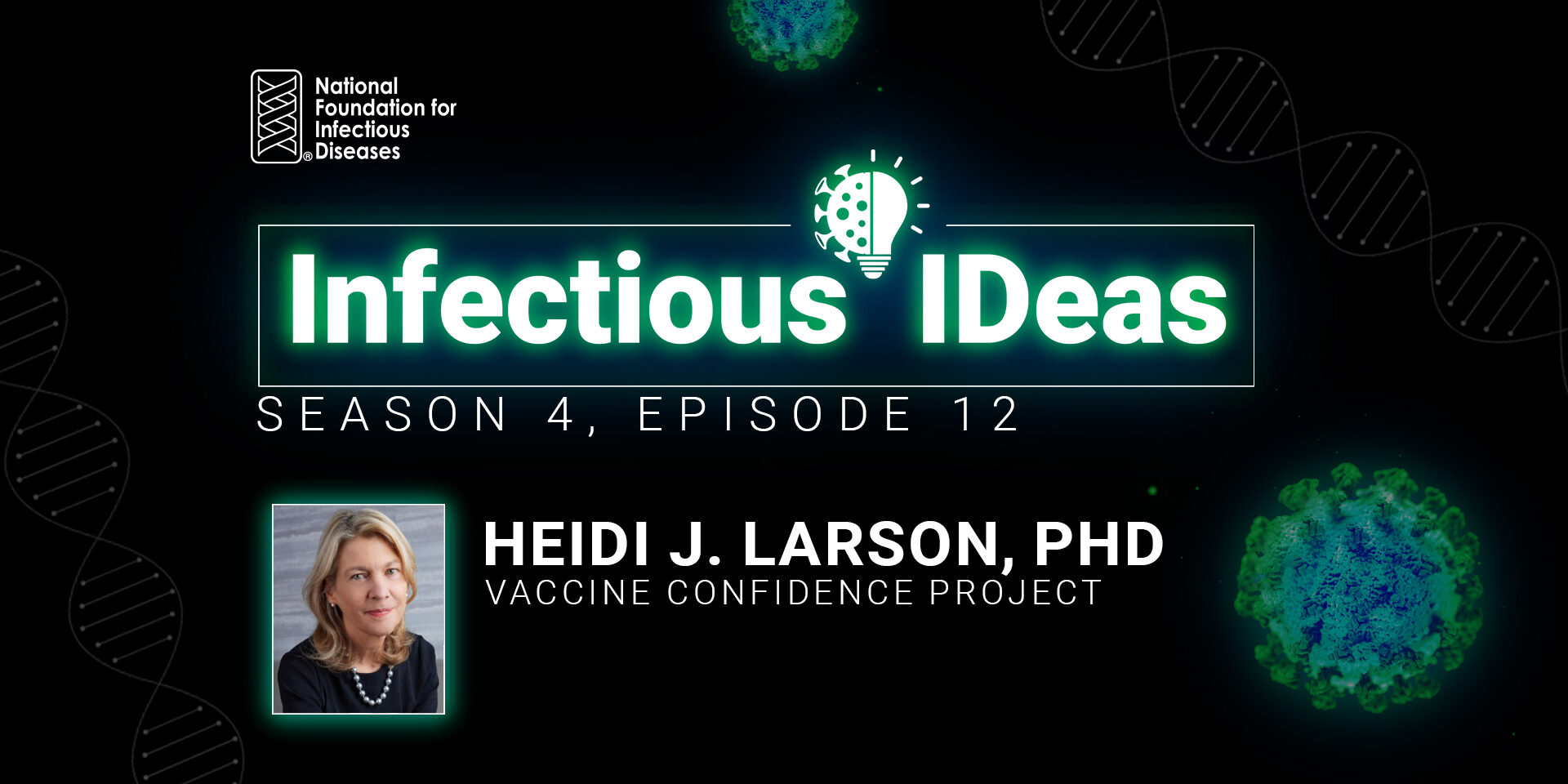
Season 4, Episode 12: How do we build trust in an era of misinformation, social media, and artificial intelligence? In this episode of Infectious IDeas, NFID CEO Rebecca Alvania, PhD, MA, MPH, and NFID Medical Director Robert H. Hopkins, Jr., MD, talk with Heidi J. Larson, PhD, director of the Vaccine Confidence Project and professor of anthropology, risk, and decision science at the London School of Hygiene & Tropical Medicine.
Drawing on decades of research and experience, Larson explains why vaccine hesitancy is often a relationship challenge rather than simply an information problem. She discusses the importance of active listening, the evolving role of digital platforms and AI, and the central role of trust-building in public health.
The conversation explores how healthcare professionals can foster meaningful dialogue, why communication deserves greater investment, and what gives Larson hope for the future.
Listen on Apple
Listen on Spotify
Transcript
Alvania
Welcome to the NFID podcast, Infectious IDeas. This is Rebecca Alvania, NFID CEO, and with me is my co-host, NFID Medical Director, Dr. Bob Hopkins.
Hopkins
Great to be here, Rebecca.
Alvania
Today we’re joined by Dr. Heidi Larson, professor of anthropology, risk, and decision science at the London School of Hygiene and Tropical Medicine. A global leader in understanding vaccine trust, she founded the Vaccine Confidence Project in 2010 and, more recently, the Global Listening Project to help drive understanding of what it takes to build resilient societies and prepare for public health crises.
Dr. Larson’s career has been devoted to exploring critical questions about who people trust when making decisions about their health, and how we as a society can strengthen trust to improve not only vaccine confidence but also outbreak response and pandemic preparedness.
Heidi, welcome. Thanks for joining us.
Larson
Nice to be here. Thanks.
Alvania
Let’s start by hearing more about your really interesting career path. Can you walk us through how you decided to work in anthropology, and then how that translated into a very successful career as a public health thought leader?
Larson
I wanted to be a biomedical engineer I was at Harvard, and got a travel grant and I ended up spending a year in Israel looking at childhood and adolescence in a lot of places we can’t go now, and then started to work with Save the Children in Gaza and West Bank, and in Nepal, and then moved to UNICEF and particularly with UNICEF, saw these programs starting without really thinking about the context they were landing in.
I started finding myself turning more and more to anthropologists and community leaders, and to see how they could help make the good ideas we had fit, because sometimes I felt these people have lives, and did the things we were coming to support long before we came along, and how does this fit in that?
And that’s really when I decided to apply to anthropology, and I went back and did my PhD at Berkeley, and it changed my whole thinking, and actually anthropology is a lot of what your training is about, listening and in a very kind of systematic way, and making sure you never only listen to one–minimum of three different perspectives, and ideally more.
It’s really been a valuable foundation. UNICEF asked me to come back to launch GAVI, the Global Alliance for Vaccines and Immunization. I ended up getting the nickname of the director of UNICEF’s fire department, because we saw more and more places where our heroic efforts to introduce all the good things that’ll save lives were starting to be questioned, and were starting to get resistance. The rest of the story starts with my leaving to found the Vaccine Confidence Project, which on the one hand I think has been really valuable. On the other hand, sometimes I feel like the situation has gotten worse. What did we do wrong? But I do think we’re in a better position to try to tackle the challenges we have ahead, and there are far more coming down the pipeline with AI.
Hopkins
So, Heidi, you’ve built so much of your work around listening. How can we take active listening and use that to address some of the biggest challenges we’re seeing today in public health?
Larson
Active listening in itself is a trust builder, the Global Listening Project has done really intensive work in 70 countries. We really wanted to listen to people’s experience during Covid, during the pandemic, who did they trust? Who did they turn to? And one of the first questions we got is, you care about what we think? We haven’t had a voice in years, particularly during Covid, we feel like there’s things we could have contributed, but nobody paid attention to what mattered to us, which to me just crystallized why we need more listening.
I do think we have to do more than listen, even though I think that’s important for relationship building. People feel like it’s not just about the jab in arms, as they say, or flattening the curve, or checking one more box off of the checklist of what you have to do, but that you care about them as a person, as a mother, or as a family member, or an individual, by just saying, How are you?
To be honest, I think there are a lot of fantastic doctors who really are great listeners, so I just want to make clear that I respect that. It’s really also partly having systems listen.
A lot of research on trust in science or trust in the healthcare professional is very singular. How much do you trust X or Y? But we really need to look at the kind of ecosystem of trust and find out who else they’re trusting, because you can have 70% trust in the scientist, but you’ve got 80% trust in your religious leader and 90% trust in your family, and the GP is somewhere more in the family, so I think that helps understand who we have to pay attention to and engage.
Alvania
You mentioned AI earlier, and as you’re talking about who people listen to and trust, one of the areas that you focused on recently are digital platforms, algorithms, how those are shaping what people see and what they trust. So, can you talk a little bit about how today’s public health information environment is different from what we experienced even just a few years ago?
Larson
We have a much more aggressive, demanding public than we’ve ever had. It’s tough. Covid was extreme, but when we started to look through the literature, this has been a growing issue of aggression and violence from patients’ families, from people coming into clinics.
So, there’s some tension going on, and some of it is people have a lot more access to information, so they think they know the diagnosis better than the doctor, or the outcome wasn’t what they wanted, and also when the cost of health is getting higher, people have a different expectation of it. There’s also a lot more people putting pressure on limited systems. We’ve got a much more challenging environment, and a lot more stresses
There are things that AI and platforms can help alleviate, and things that maybe they’re not best suited for. How do we reduce administrative tasks with the support of AI and others? Do we really want patients just turning to the AI chatbot? I don’t think it’s going to be the solution. I think everyone wants to talk to a real person. I’m very concerned about the Stop AI movement, extremely concerned, particularly having studied the dynamics of how the vaccine dissent groups have grown. it’s very highly organized, and it’s become very mainstream in a lot of ways we have to be very careful with how we engage and use technology It shouldn’t be us sitting in our offices figuring out ways to do it. We need to be at the table with patients, with doctors, with others, with community, with visiting nurses associations, with whoever to make it acceptable, to make it practical, to make it appropriate to what they need. And we’re not doing enough of that, and that’s where listening to them, how we can be more effective, and how we can use these new tools is going to be really important.
Alvania
We’d like to take a quick break from Infectious IDeas to talk about the important work of the National Foundation for Infectious Diseases. NFID remains dedicated to providing trusted, evidence-based information to protect public health and empower individuals to make good decisions about their health. But we can’t do it alone. Your support helps us address misinformation by sharing reliable resources to keep individuals, families, and communities safe from preventable diseases. Visit nfid.org/donate to make a difference today.
Hopkins
So, Heidi, a core idea in your work is that vaccine hesitancy is a relationship problem rather than just an information or misinformation problem. I’m a primary care adult and pediatric doctor. How can people like me, how can healthcare professionals build relationships to better address the underlying feelings that many may have of being disenfranchised or just not being heard?
Larson
I’ve come to the conclusion that it’s more of a relationship problem because of the number of parents who have contacted me, one way or another, about why don’t they hear us? Can you please let your colleagues know that some of us really want to get our kids vaccinated, but we’re being reprimanded for even asking questions, we’re being judged, we’re being told we’re not good parents, and can you please tell them if they would just speak nicely, we’d get our kids vaccinated.
Sometimes people come in and they say I really don’t want that x vaccine because of x y and z, and there’s a temptation to jump in and give the safety issues and say it’s really there are x number of kids dying or very ill or even disabled, and our tendency is to be very defensive about things we know, because we have a lot of evidence, but what they want to hear is, I understand your concern, and are there other things about it that are worrying you or whatever, and then the conversations open, and I think that’s part of what I was mentioning before, in terms of listening as a trust builder.
Hopkins
Take the time to ask the question, can I ask you about this, lean in, so to speak.
Alvania
Heidi, you talked a little bit about challenges earlier when we’re talking about AI digital platforms, but if you take a step back and just think about public health in general, now what concerns you the most about where we’re at?
Larson
What concerns me the most in public health is we’re not where people are in terms of information environment, we may be in terms of the location of some of our clinics, but we have, for example, been very anxious and hesitant to be in the social media space. It’s unedited, it’s not controlled, it’s dangerous. I think it’d be less dangerous if we had gotten engaged when the rest of the population got engaged. We’ve rolled out the red carpet to alternative views, and people now talk about social media as the kind of bad stuff.
It doesn’t have to be bad, we’re just not there, so I think we really need to get with the program and get with the public now, like really now, because it’s moving so fast and they are so quick to get way ahead of us in terms of engaging new technologies, at least when it comes to the information and influencing environment. But I do think that public health also has penny budgets for communication and engagement. It needs investment, it needs support, it’s not free.
Hopkins
Given the many challenges in public health today, let’s turn it the other direction. What gives you hope for the future?
Larson
The thing that gives me hope is the number of young researchers, the innovation. I think we have tremendous opportunities with some of the new technologies that are available. I think there are a lot of very bright and inspiring young people. I just came back from meetings in South Africa and in Tanzania, and the level of enthusiasm for science and engagement is really my hopeful moment, just hoping that we can keep their enthusiasm alive, and they don’t get discouraged by the current environment.
Alvania
You’ve had such a fascinating career, and you’ve had so much impact, but when you think about the areas in which you’ve worked over the years, the impact that you’ve had, what would you point to as what you’re most proud of?
Larson
I think it’s really the students and the young people who have worked with me. They’re the ones. When I see them shine, I just have a huge smile. I put a lot of time into supporting people who’ve worked with me, and a lot of them have really stuck with me through multiple relationships, children getting married, and they just keep coming back, and it’s such a joy. And also, giving time, I have high school students from all kinds of countries who reach out and want to learn, or hear, or ask me to talk to their class. Those are good moments when I feel like there’s a chance to hopefully inspire some of these kids.
Alvania
That’s amazing, that outreach from high school students.
Hopkins
So, Heidi, if you talk about starting with an interest in the biomedical engineering field, you’ve migrated through anthropology and public health. As you look back now, if you’d gone in a different direction, what career path might you have chosen?
Larson
I love engineering, and I think some of the basic things I loved about engineering I see in my daily life: the problem-solving part. I do a lot of problem-solving these days in this complicated environment.
I don’t think I would have changed my path; I might have shortened a few places I had been. With my students, I find what they really love is that I’ve been out there, and it’s not just theoretical, or it’s not just textbook driven, or it’s a combination, just because I followed what I cared about doing, not because I had any kind of grand plan at all, and that’s what I try to encourage people working with me to stick with it, but it’s tough. It’s a very different environment for students, for young researchers, than it was when I was starting. Having said I wouldn’t change my career path, if I were to start now, I think I would probably go into neurology and brain science.
In leading this Lancet Commission on the Emotional Determinants of Health, I’ve managed to bring together commissioners who are evolutionary biologists, neurologists, psychiatrists, anthropologists, different kinds of areas, and it’s been a fascinating journey, and I think it’s definitely an area that I would invest in again.
Alvania
I’m a neuroscientist by training, so I completely agree with you. The brain science is the most fascinating. You’ve spent so much of your career listening. So, before we wrap up, can you tell us about one myth or perspective that you would love to just set the record straight on if you could.
Larson
I think the most common myth or rumor that cuts across all kinds of health interventions is fear of sterilization. Really, it’s quite existential. It’s an anxiety, it’s about distrust of the motive, whether it’s government or whether it’s the producer of whatever the intervention is, particularly in highly marginalized people who have a lot of existential and rightly concerns. Just about every health intervention at some point has hit a sterilization fear, but that’s a tough one, because that’s very deep and it’s not really driven by the product itself, and that’s an example of one that you start talking about the safety of the product or information about it, that’s going to go nowhere. It’s not going to change their mind. Feeling like you care about them, their community, and want them to be healthy—and are there other things we can do to keep you healthy—might help mitigate the sense that you’re trying to get rid of us.
Hopkins
We’ve been talking today with Professor Heidi Larson about communication, listening, trust, resilience, and public health preparedness. I want to thank you again for joining us, Heidi, and thanks to all for listening to this episode of Infectious IDeas, a podcast presented by the National Foundation for Infectious Diseases, where leading experts join us for thought-provoking conversations that lead to infectious ideas. Be sure to subscribe to the podcast on Apple, Spotify, or whatever you listen to your favorite podcasts on, and if you’d like more information about NFID, be sure to visit us online@nfid.org. Until next time, stay safe, stay healthy, and get vaccinated.