
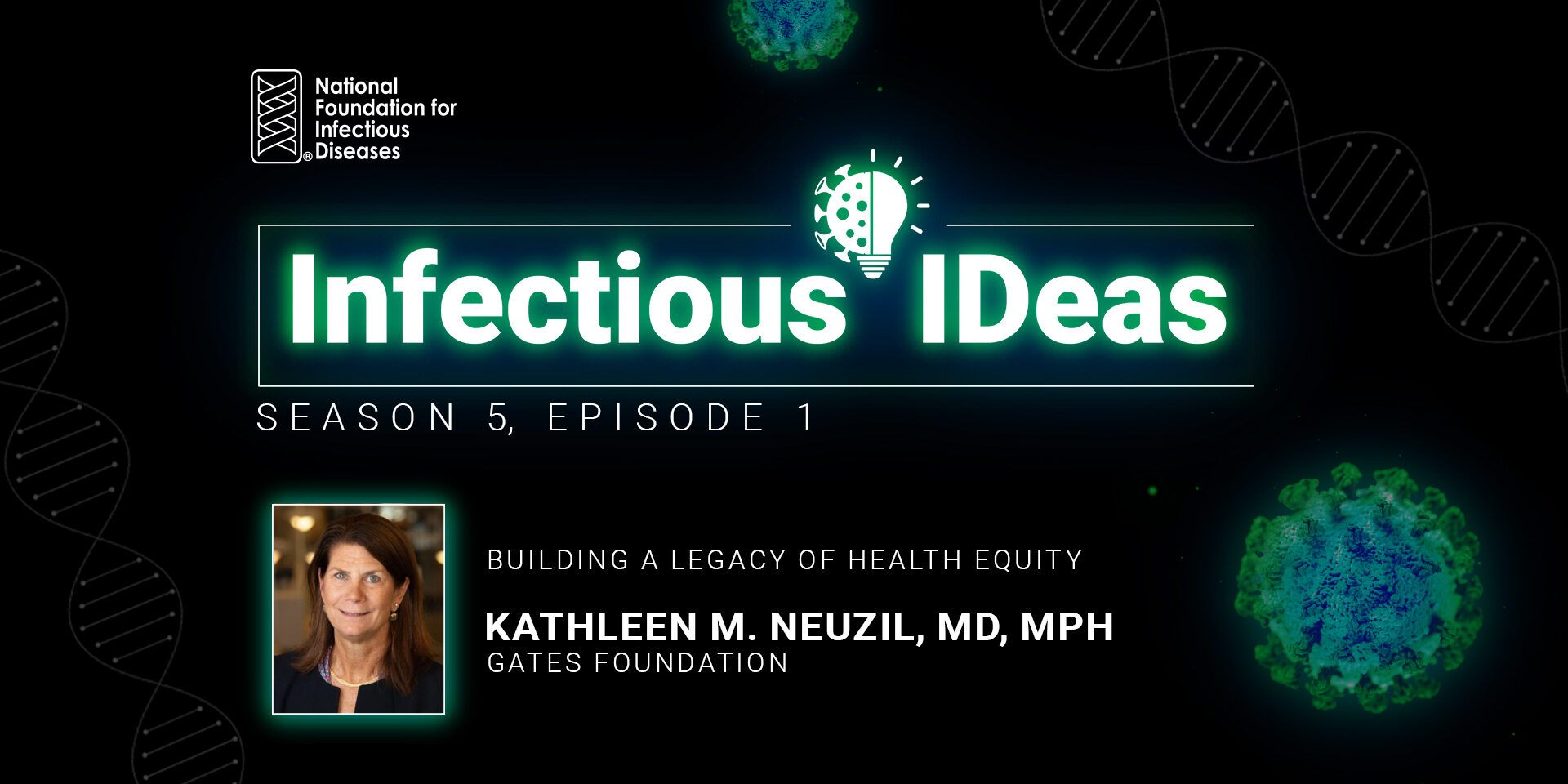
Season 5, Episode 1: What does it take to eradicate a disease like polio, and why does vaccine equity matter as much as scientific innovation? In this episode of the Infectious IDeas podcast, NFID CEO Rebecca Alvania, PhD, MA, MPH, and NFID Medical Director Robert H. Hopkins, Jr., MD, welcome Kathleen M. Neuzil, MD, MPH, of the Gates Foundation and recipient of the 2026 NFID John P. Utz Leadership Award, for a lively discussion on global immunization policy, disease surveillance, and the effort to eradicate polio.
Neuzil reflects on the people who shaped her career, advances in vaccine science, the funding and communication challenges facing public health today, and why health equity must be central to any eradication effort. She also shares why she remains optimistic that the next generation can build a healthier, more equitable future.
Listen on Apple
Listen on Spotify
Transcript
Alvania
Welcome to the NFID podcast, Infectious IDeas. This is Rebecca Alvania, NFID CEO, and with me is my co-host, NFID Medical Director, Dr. Bob Hopkins.
Hopkins
It’s great to be here, Rebecca.
Alvania
Today we’re joined by Dr. Kathleen Neuzil of the Gates Foundation, who’s played a pivotal role in advancing global immunization programs and shaping public health policy both domestically and internationally. At Gates, she leads efforts to eradicate polio and strengthen immunization and disease surveillance systems. She previously served as director of the Fogarty International Center at the National Institutes of Health, where she oversaw global health research and training programs. She’s led large-scale clinical trials of vaccines for influenza, rotavirus, typhoid, HPV, and COVID-19, often in low- and middle-income countries.
In recognition of her outstanding leadership and service, the National Foundation for Infectious Diseases will honor her with the 2026 John P. Utz Leadership Award at the NFID Awards Gala in October 2026. Kathy, thank you so much for joining us.
Neuzil
Thank you, Rebecca. Really wonderful to be here.
Alvania
Let’s start at the beginning. Who or what inspired you to work in infectious diseases and vaccinology?
Neuzil
That’s an easy answer. That would take me back to medical school. I was a medical student at Johns Hopkins, and you’re a bit overwhelmed in those early years with a lot of new vocabulary and scientific concepts. I remember getting to the third year and having the lectures on vaccines, including Haemophilus influenzae B, which was the leading cause of meningitis in young children, the leading cause of acquired deafness in infants. Hearing about vaccines on the horizon, hearing about the 1918 influenza pandemic that killed 10s of millions, and the possibility of better vaccines, and what that would have done at the time. So, really, it started in medical school, that excitement about preventing a disease rather than always treating a disease.
Hopkins
What are the greatest changes that you have seen in infectious diseases and vaccinology from those early days in your career?
Neuzil
The science is really just remarkable, and maybe I’ll start with the diagnostics. When I started my research career, I did a lot of work in influenza, and a lot of that was epidemiology, right? We would see the winter come, and the number of emergency room visits would go up, and we would know it was influenza season. But we never recognized that infants and young children actually get sick with influenza until we had a diagnostic that told us that this nonspecific but potentially severe febrile illness was influenza.
I look at what I’m doing now with polio, and our ability to detect polio, COVID-19, and even TB and HIV in wastewater, doing simple wastewater surveillance that we never could have done before. And precision vaccinology has just been amazing. The way we can have these target antigens—for the new RSV vaccines, for example, the COVID-19 vaccines—has advanced the field in ways we couldn’t have imagined when I started out.
Alvania
Your work has informed immunization policies at the US Centers for Disease Control and Prevention and World Health Organization. Recognizing the challenges that we face both in the US and globally, what do you feel are the greatest threats, but also the opportunities in infectious diseases?
Neuzil
It’s really been a tremendous honor to work in this field and work with those organizations. One aspect where I always felt in vaccinology that we had an advantage over other fields, is that if we garnered the evidence and presented the evidence that led to a policy, then we had financing for the vaccine. In the US, through the Vaccines for Children Program, in the World Health Organization and in less-resourced countries, if SAGE [the WHO Strategic Advisory Group of Experts on Immunization] made a recommendation for a vaccine, Gavi [The Vaccine Alliance] would support it.
I’m really quite concerned about the global funding situation right now, and the difference it will make. As we’ve seen throughout history, rich people will be able to access vaccines as they can access other medical interventions. But what made vaccination so powerful is the ability to reach all, which includes the financial ability to reach all. In my view, as a society, we have to continue to support funding for these diseases and for these vaccines that are so powerful.
Alvania
Kathy, at Gates Foundation, you’re focused on polio, so could you talk about the global status of polio and some of the major challenges we’re facing?
Neuzil
Being part of the global partnership with the goal to eradicate polio is one of our major emphases here at the Gates Foundation. The World Health Assembly in 1988 adopted a resolution for the eradication of polio; since then, polio cases have decreased by over 99%. We had about 350,000 cases a year at that time, and now there are only two countries that are still endemic for polio with less than 100 cases.
Again, we are almost there, but that rest of the way still presents some challenges. This is a highly infectious virus. It enters through the mouth and contaminated water or contaminated food, and can spread very easily. It would not take much for polio to again recur in many countries throughout the world. As with other infectious diseases, it does not respect borders. With conflict, with population movement, with declines in funding for surveillance, this is a difficulty in terms of getting to those final stages without actually having polio worsen. Partnership is a huge part of this collaboration. Every country in the world, working together towards this common goal.
Hopkins
Kathy, I recognize this is going to be a really challenging question, but who do you most admire and why?
Neuzil
I’m going to start with Edward Jenner, but for a reason that may be a little different than the one that most people are thinking. Of course, Jenner is known for being a pioneer in vaccinology and the smallpox vaccine in particular. What most people don’t know—unless you’re really a nerd like me and go back and read some of the original papers—is that from the beginning, so in the late 1700s, Jenner was saying that the annihilation of smallpox has to be the final result of this vaccination practice. He had the vision to recognize that eradicating this disease should be our goal. I have so much admiration for his pioneering science, but also his vision to be thinking about these bold ideas. Now that I’m working in polio eradication, it really comes full circle. What’s the ultimate health equity? It is eradicating a disease where we all benefit equally.
Alvania
In addition to your scientific contributions, you’re also recognized for your mentorship and your advocacy for women in science. What advice do you share most often with the next generation, and particularly the next generation of women in science?
Neuzil
I think one of the best pieces of advice is, do what you like to do. This is a very long career. Work with people that you like to work with and have fun. There are challenges for all of us. But I have truly loved what I do.
Scientifically, the really good advice that I was given was, start at the beginning and ask the right questions. Don’t lose that focus on why you’re doing the research or why you’re doing the project. These are very simple pieces of advice, and yet very powerful. You’re focusing your time on what you like and what is important. With all of the distractions in the world today, I try to remind my mentees, enjoy what you’re doing, enjoy the people that you’re working with, and really focus on what’s important.
Hopkins
And resilience in that enjoyment is so important in our current era.
Neuzil
Yes.
Hopkins
So, Kathy, as you think about your legacy, what do you hope people will remember most about your contributions, not just in science, but about you as a human being?
Neuzil
I had such great role models in mentorship that I certainly want to give back in that way.
As I really think about it, though, I hope that people will see me as a champion for health equity. I’ve worked on rotavirus vaccines, I’ve worked on typhoid vaccines, and particularly polio now. To most of us today, this isn’t affecting our lives, but these are still very real and present diseases. I did some work in Niger with the surgeons there, and see hundreds of children come in with intestinal perforations due to typhoid, and say, what is wrong with this picture? As a traveler, I would not go to Niger without having a typhoid vaccine. And yet children living in this country every day have no access to a typhoid vaccine. I’m pleased to report Niger did a national typhoid vaccine campaign at the end of 2025. I’m just very passionate about the health equity aspect of what I do, and would love if that was part of my legacy.
Alvania
It’s obviously a really challenging time right now in public health. We all need time and ways to unwind and decompress, so what are you most excited about when you look forward, either professionally or personally?
Neuzil
I’m certainly excited to be here at the Gates Foundation at this moment in time. Bill Gates announced his intention to close the foundation in 2045 and to spend down his fortune in 20 years. It’s now 19 and a half years. So, what a privilege for me at this point in time, when resources are scarce and global health funding is dropping, that I’m working in a place that’s really committed to be sure that these substantial resources are used in the best possible way. To be working with this amazing group of people and others around the world on polio eradication, again the ultimate sustainability, the ultimate legacy that everyone can benefit from.
I’m now a grandmother; I have three young grandchildren. They are all fully vaccinated, and to think that my grandchildren and their children will live in a world where no child has to worry about being paralyzed, no mother has to be concerned that their child might be paralyzed. What a privilege to spend this later stage in my career on that goal.
Hopkins
Oh, that’s very inspiring, Kathy. I haven’t heard it said better. Knowing what you know now, what, if anything, would you do differently in your professional life? Any regrets?
Neuzil
When you’re going through internship and residency, and then you’re having children, and you’re exhausted, right, and you’re always thinking, should I do this and should I do that. But with the benefit of a good night’s sleep, and looking back over the years, every challenge really is an opportunity, and every little detour—when I worked in a lab, when I was vaccinating mice—it all contributed to where I am today.
I think my one regret is, I would have learned French. While you can get away with interpreters, and with most of the world speaking some form of rudimentary English, French is a beautiful language. I’ve worked a lot in Francophone countries and would have paid a lot more attention in that high school French class, I think, Bob.
Hopkins
One final rapid fire question for you, Kathy: what one word would you use to describe the state of public health today?
Neuzil
Fragile. I really am optimistic. We have a lot of scientific tools that we never had before. We have philanthropists, still putting money into important diseases.
And yet there’s a lot of geopolitical turmoil. We have a record number of displaced persons. We are seeing outbreaks. We have an Ebola outbreak, which we know is quite serious, and we are constantly dealing with the resurgence of measles. There are tipping points with these diseases, where it could be very hard to recover.
This really is a moment in time to take action and ensure that we focus. We clearly have not communicated well the value of vaccines, for example. So I am optimistic. I do worry, though, that with the geopolitical and financial fragility, we have to stop the decline.
Hopkins
The fragility in terms of public health, funding for science, opportunities for young people to get their feet on the ground and be supported in an early research career, so that they can be successful going forward.
Neuzil
Yes, absolutely.
Hopkins
All very important messages, all very important challenges for us going forward. We’ve been talking today with Dr. Kathleen Neuzil, a pivotal voice in advancing global immunization programs and public health policy.
I want to thank you again for joining us, Kathy, and thanks to all for listening to this episode of Infectious IDeas, a podcast presented by the National Foundation for Infectious Diseases, where leading experts join us for thought-provoking conversations that lead to infectious ideas. Be sure to subscribe to the podcast on Apple, Spotify, or wherever you listen to your favorite podcasts. And if you’d like more information about NFID, be sure to visit us online at nfid.org. Until next time, stay safe, stay healthy, and get vaccinated.