
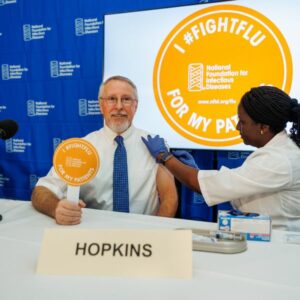
 Special thanks to NFID Medical Director Robert H. Hopkins, Jr., MD, for this guest blog post examining the challenges—and stakes—facing the immunization community in the year ahead.
I am a grandfather, a primary care physician for more than 30 years, and a national advocate for vaccination as one of the most critical—and increasingly threatened—tools we have to protect the health of people of all ages in the US.
During my training in internal medicine and pediatrics in the 1980s and early 1990s, I routinely cared for patients with vaccine-preventable diseases. I treated older adults suffering from severe, unremitting pain caused by shingles, younger adults hospitalized with pneumococcal pneumonia and sepsis, adolescents with severe staphylococcal pneumonia caused by influenza, children with Haemophilus influenzae meningitis, and countless infants and young children hospitalized with respiratory syncytial virus (RSV). I saw my first case of measles in a fellow trainee in 1992.
These diseases were not theoretical—they were real, devastating, and often life-altering. Those experiences, and many others, led me to dedicate much of my career to clinical vaccinology.
Over the years, I have spent countless hours teaching colleagues in medicine, nursing, and pharmacy—as well as members of the public—about vaccines, vaccine-preventable diseases, and the critical role immunization plays in protecting individuals, families, and communities in my home state of Arkansas and across the US.
In my practice, I have also spent a great deal of time listening. Many patients and families have questions about vaccines, including concerns about safety and whether vaccination is truly necessary for them or their loved ones. In most cases, these questions led to thoughtful, respectful conversations about why I recommend vaccination. More often than not, patients ultimately chose to get vaccinated—sometimes during that first visit, sometimes later. It was rare that we could not agree that we shared the same goal: doing what was best for the patient.
My patients, colleagues, and I weathered the COVID-19 pandemic. The first year—before vaccines were available—was an extraordinarily difficult time. The period when vaccines were available but access was limited was also deeply challenging. Even after we returned to more normal operations, questions about COVID, COVID vaccination, and long COVID remained common. Patients and healthcare teams were exhausted, and conversations about vaccines became more challenging in the context of that fatigue. Still, most discussions remained grounded in mutual respect.
Today, however, the environment has changed. The challenges we face extend beyond pandemic exhaustion.
In recent months, significant disruptions across the Department of Health and Human Services, Centers for Disease Control and Prevention (CDC), Food and Drug Administration (FDA), and National Institutes of Health have gutted support for critically important public health programs and scientific research. This includes setbacks to the development of mRNA vaccines—a major scientific breakthrough that has the potential to protect lives in the face of emerging threats such as bird flu, should it become transmissible between people. Undermining this research puts our future preparedness at risk.
At the same time, the Advisory Committee on Immunization Practices (ACIP)—long composed of independent external experts and supported by dedicated CDC staff and medical specialty liaisons—no longer functions as the trusted, evidence-based body it was for decades. For generations of clinicians, ACIP served as the primary source of rigorous, transparent vaccine recommendations to guide patient care and protect public health. That clarity and confidence have eroded. Compounding this uncertainty, public statements casting doubt on FDA-approved vaccines have, at times, conflicted with the conclusions of the scientific experts who conducted the underlying analyses.
I see the consequences of this confusion every day. Many people are afraid they will not be able to access life-saving vaccines for their children, partners, or parents. Others worry they will not be able to afford vaccines even if they are available. Some cannot reconcile the conflicting and often misleading sources of information and delay vaccination out of fear of making the “wrong” decision for their loved ones. Still others are angry, believing they were misled about vaccine safety and effectiveness by influencers or other individuals in positions of power. I hear these concerns every day in my own practice and from my colleagues across the country.
My message is the same today and will be the same tomorrow: First, do no harm.
I will continue to review the evidence, trust the science, and make the best decisions I can to protect and improve the health of those I serve. I will continue to teach this science and to advocate for these principles to those whom I have the privilege to teach or encourage.
Vaccines have saved millions of lives and prevented billions of dollars in healthcare costs in the US during my lifetime. They have allowed generations of children to grow up without fear of diseases that once filled hospital wards and claimed lives.
I have a new grandson, born just over a month ago, and I want him to enjoy the benefits of a life without chickenpox, shingles, mumps, severe influenza, polio, severe RSV, rotavirus, tetanus, and other diseases we can prevent or minimize with vaccines. Protecting that future requires a continued commitment to evidence, transparency, and trust. We must move forward to a healthier country—not backward to a time marked by thousands of cases of measles, whooping cough, or polio.
To join the conversation and get the latest news on infectious diseases:
- Like and follow NFID on social media
- Listen and subscribe to the Infectious IDeas podcast
- Subscribe to receive future NFID Updates