
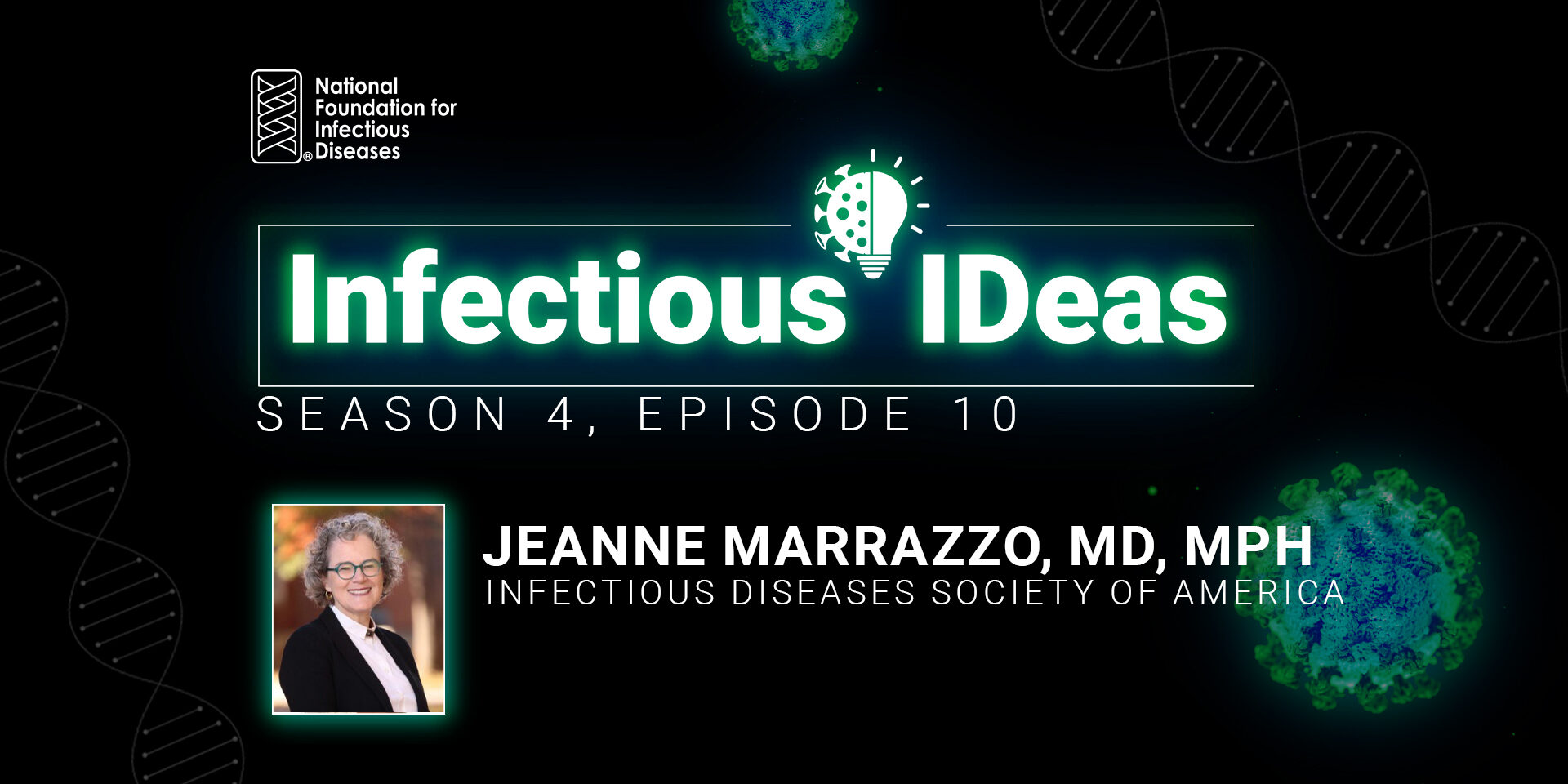
Season 4, Episode 10: Is the US losing its edge in biomedical research—and what does that mean for the future of infectious diseases? In this episode, Jeanne Marrazzo, MD, MPH, CEO of the Infectious Diseases Society of America and former leader at the National Institute of Allergy and Infectious Diseases, joins hosts Rebecca Alvania, PhD, MA, MPH, and Robert H. Hopkins, Jr., MD, for a timely, thought-provoking discussion on the future of public health and scientific research.
From the early days of HIV to today’s complex public health landscape, Marrazzo shares a candid look at the forces reshaping infectious diseases, including threats to scientific integrity, shifting research funding, vaccine confidence, and declining public trust. The conversation also explores what’s at stake for US leadership in biomedical research, the impact on global health, and why patient advocacy and strong scientific voices are critical now.
Listen on Apple
Listen on Spotify
Transcript
Alvania:
Welcome to the NFID podcast, Infectious IDeas. This is Rebecca Alvania, NFID CEO, and with me is my co-host, NFID Medical Director, Dr. Bob Hopkins.
Hopkins:
Great to be here, Rebecca.
Alvania:
Today we’re joined by Dr. Jeanne Marrazzo, an internationally recognized infectious diseases physician-scientist and the new CEO of the Infectious Diseases Society of America. Before taking on this role, she served as Director of the National Institute of Allergy and Infectious Diseases at the NIH. She spent decades advancing research on HIV, sexually transmitted infections, and global health. Her appointment to lead IDSA comes at a pivotal moment for infectious diseases and for the scientific community. She’s recognized by peers as a respected scientist and trusted leader at a time when strong voices for scientific research and evidence-based public health are especially important. Jeanne, thank you so much for joining us.
Marrazzo:
It’s great to be here with you both, thanks for having me.
Alvania:
Your career has been remarkable. You’ve spanned frontline patient care, scientific research, public health response, and high-level government leadership. But take us back to the beginning and tell us about how you first found your way into the field of infectious diseases.
Marrazzo:
Like many people of my generation, we were caught up in the early days of HIV care. My first real experience with HIV was in the 80s, before people really knew very much about it. Before I went to medical school, my mom was an oncology nurse in Scranton, Pennsylvania. At that point, there were a lot of young men returning to their families from New York City or Philadelphia to die, because that was all that was happening. I always remember her telling me that there were many physicians and nurses who refused to take care of those patients. My mom was not exactly a social activist, but she was quite outraged about that. So, she was a real inspiration.
When I did go to medical school, and ultimately to residency in New Haven, there was a pretty bad outbreak there. That was interesting, because it was cross-demographic, not just men who had sex with men, but also a lot of young women, a lot of injection drug users. So, it became a real focus for most of us. In our residency, we had a whole floor, actually, of people who were living with HIV and then dying with HIV. People weren’t living with it so well at that point. I got really interested in it, and also liked the biology of it, the infections associated with it, and also the social justice and advocacy around trying to take care of a highly stigmatized disease that was robbing very young people of many productive years of their lifetime, and was a global phenomenon, as we learned painfully in the subsequent years. So that’s how I really got started.
Hopkins:
Jeanne, those were very difficult days back in the 80s, and we’ve come so far, and still have so far to go. You recently concluded your tenure leading the National Institute for Allergy and Infectious Diseases and are now stepping into your new and challenging role at IDSA. What entices you and excites you most about taking on this next chapter in your career?
Marrazzo:
I feel lucky to have taken on this job for a couple of reasons. First of all, I feel strongly that professional societies like ours are the last line standing. We are one of the few entities that can continue to speak truth to power and really call out what’s happening. The anti-science biases that we’re seeing, particularly against vaccines, is really affecting pharma’s appetite for engaging in these kinds of conversations. A lot of individuals are speaking out, but I think we need people with professional stature, who are well respected and have led large groups to continue to carry this flag forward.
IDSA is one of the co-plaintiffs in the lawsuit against the Secretary regarding the Advisory Committee on Immunization Practices (ACIP) members. It was a great opportunity to continue to be able to advocate for what I think is scientific integrity that is at risk. And very importantly, to advocate for the next generation of scientists. So, lots of work to do.
Alvania:
The field of infectious diseases is evolving, as all fields do scientifically, from emerging pathogens to antimicrobial resistance. There are workforce challenges, shortages, and all the policy issues that you were just talking about. From where you sit today, what issues do you feel are most consequential?
Marrazzo:
Let’s start with just the infectious disease field as I know it, as an academic physician-scientist who has done a lot of translational work, both domestically and globally. When you look at the number of grants that have not been awarded in the past year, which has plummeted, and when you factor in that these decisions are being made around political priorities, frankly, it’s chilling and it’s devastating. Universities, because they’ve had to constrict, are just unable to provide the kind of bridge funding that people need to navigate those challenging gaps in funding.
I’m worried about that, just in terms of keeping people alive and keeping them in the game, which really affects our ability to be the primary research powerhouse in biomedical science in the world, big time. My biggest fear is that we’re going to lose that position, and I think we will for a period of time. There’s no question that other countries are not only picking up our great people but barreling ahead with many of the technologies that have been threatened.
NIAID funded the majority of infectious disease research, not just in the US, but globally—70% of tuberculosis research came from NIAID. Devastating is not too strong a word to use. The other thing is the decimation of CDC from the surveillance standpoint and also from the global networking standpoint. Many countries have emulated CDC. They’ve wanted to create their own CDCs—and indeed, they have—all because of the strength of the CDC.
When you lose that network and the secure knowledge that what you’re hearing about an outbreak is real, you lose your window into what’s happening globally. And I’m very concerned about that, especially given the chaos that is engulfing our world right now, and especially given the fact that biopreparedness has been explicitly downplayed. It’s a perfect storm of potential badness, and I just hope we can get through this period without seeing the worst effects of it.
Hopkins:
Vaccines have remained one of our most powerful tools to prevent infectious diseases, yet we’re also seeing skepticism fueled by rumors and false information. From your perspective, what will it take to rebuild and to sustain public confidence in vaccines?
Marrazzo:
It’s going to be a long game, because you can see, just for example, how influential the perch of the Secretary and the White House is when you look at women who stopped taking Tylenol when they were pregnant. You may try to point out that these are not evidence-based claims, but when you have a pulpit like that, people pay attention, as we wish they would have always when the advice coming out was evidence-based, which, frankly, it’s not right now.
So, there are a couple things going on at the same time. There’s been an active effort to discredit those of us who were present before, taking down the entire ACIP, getting rid of career scientists at NIH, getting rid of leadership of the institutes at NIH. You’ve got this situation where the administration is not trustworthy because we don’t know where those recommendations are coming from in terms of evidence. They’re not justifiable or evidence-based, and then at the same time, they’re undermining the other agencies that we traditionally have trusted, so CDC, NIH, even WHO, which we’ve now pulled out of.
I think the damage is pretty epic. In the meantime, people still believe their doctors, and if they can see these organizations as physician led, healthcare team led, really caring about patients, not the politics, not the policies, even—just the patient in front of you who needs solid advice—then I hope that’s a way out, which is one of the reasons, again, I think professional societies have a big role to play.
Alvania:
You talked about scientific integrity. We know that political priorities have always had some influence over what science gets federally funded. We’ve had the BRAIN Initiative, the Cancer Moonshot, but talk to us about when that crosses a line, and then also what organizations, like IDSA and NFID, can actually do when those lines do get crossed?
Marrazzo:
Politics has always played a role. Right? Look at the funding for tick-borne diseases, or for valley fever, coccidiomycosis. Those are important diseases, incredibly important. Believe me, I’m not suggesting we should reduce funding to them, but they are also projects of extreme interest to certain representatives in our Congress who have championed those earmark allocations for those conditions for many years.
Now, is that wrong? You could look at the distribution of funds and say, maybe we shouldn’t be spending so much on this disease, and maybe we want to shift it over there, but it’s not egregious in terms of funding bad science or funding projects that are not going to advance the health of the community. I don’t see those as crossing a line. It’s a reality of being in a democracy with people advocating for the things they care about and the things that their constituents are wanting them to pay attention to.
Where it crosses the line is where you stop funding meritorious research because A, you don’t like the population it’s about. B, you don’t think the disease matters—COVID. C, you don’t think that the methods being used are safe and might even be harmful—mRNA vaccines. The whole mRNA vaccine arena has been completely cut off from any sort of focus of funding, and that’s been related to the biopreparedness downplay. So that’s where I think the line is crossed.
I think there’s a clear distinction there, and I feel like we should talk about this. We haven’t had these conversations because things were always just percolating along. And that’s one thing I think that NIH probably took for granted, and that was a failure to really explain how NIH works, and how science gets funded. They’re not pet projects. They are, in general, very rigorously grown from a community of scientists and then curated by knowledgeable people. But we never talked about that, because we always considered it either a given or inside baseball.
So, what can societies do? I think they can stand up and say, I’m sorry, you’re putting out guidelines for HIV care and you’re leaving out trans people. So, we’re publishing our own version of [guidelines] for trans folks and non-binary folks, to complement what I think is a pretty big deficit in federal guidance. And you can think of a lot of things where that’s happening.
We’re partnering with the Vaccine Integrity Project and other organizations to develop respiratory virus recommendations for the fall. So, we’ll have recommendations for COVID, RSV (respiratory syncytial virus), and influenza.
Again, this does set up this natural tension between the existing CDC, right? There is a CDC, there is an ACIP. We are asking people to trust us. This is a shift, but you can trust us to take you through that, which is a lot to ask people, but I think that’s what we have to do. And we have to keep talking about it in a way that doesn’t continue to point a finger and divide us, because that’s just not being very helpful.
Hopkins:
You’ve mentioned some of these challenges in the biomedical research arena. As we think about support for biomedical research in the US going forward, from your perspective, what’s at stake right now and what do we need to be paying attention to for next steps?
Marrazzo:
I think at stake is nothing larger than the primacy of the United States biomedical research agenda and engine. It’s definitely shifting. China is going to be ahead of us. If not already, they will be well ahead of us in the next year to two years. If you look at papers coming out, if you look at just facilities—I was at a meeting recently where—this is just so illustrative to me—I learned that there is not a single scanning electron microscope that’s a cryo-electron microscopy in the entire continent of Africa, and there’s one that’s going to be installed. At the same time, there are 20 in Shanghai, 20 in Shanghai alone.
The scope of the investment that’s happening elsewhere, from Australia to China to France, you name it, to Canada.
We have put the brakes on hold, both in terms of awarding funding and prohibiting the pursuit of knowledge in certain areas deemed politically unacceptable. That’s really what’s at stake here. And so it’s big. It’s really big, and it’s also affecting the pipeline of people who can take forward the scientific agenda in the next couple of decades.
Hopkins:
In addition to our loss of scientists over the course of the last couple of years from the government sector as well as in academia and in the private space.
Marrazzo:
Yeah, I think it’s both—so huge brain drain from both the NIH and the CDC. That’s a lot of brain power and a lot of, equally importantly, real-world experience across the globe in combating outbreaks.
So that’s a big thing. And then with regard to NIH, we had started talking about term limits when I was there for directors, because frankly, I think 10 years is a great term limit for an NIAID director or any institute director. It is not wrong to talk about that. Change is needed. So, as we think about rebuilding, we should not build the same house we had in the next five years. I don’t know what that’s going to take, but I think it does need to look different.
Alvania:
Your own research has focused on HIV prevention, sexually transmitted infections, and these often continue to disproportionately affect communities of color and LGBTQ plus populations. What do you think it’s going to take to ensure that the clinical research advances that we’re seeing in these areas also reach the communities that need them the most?
Marrazzo:
That’s another really big challenge. I was talking recently to people in Minneapolis who have been seeing during the recent ICE processes activity, a big decline in the comfort level and ability of many vulnerable patients to come to clinic. And that is not just for HIV, but it’s also for tuberculosis, and it’s also for hepatitis—hepatitis B and C. There’s a whole spectrum of people who really just don’t have very good access to good medical care, and they rely on these structures, the public health structures, the community structures, what we used to call safety net hospitals and facilities. With them being targeted specifically, often because they’re unhoused, or they may not have citizen status, or they may be, as we’ve seen, black or brown, it creates an incredible set of barriers for people. I think we have to keep talking about that, because if we can’t take care of our most vulnerable people, then we’re really creating a very classist system that perpetuates lack of access for the neediest people.
Hopkins:
Jeanne, we’d like to ask our guests to help bring some clarity to the information overload, or misinformation overload. What’s one myth or misconception about infectious diseases that you would most like to bust?
Marrazzo:
I would like to try to get people to believe number one, the flu vaccine doesn’t cause flu, and if you get sick, it’s either because it was not a good year for the vaccine, or—very likely—you got something totally different. There are a lot of viruses out there.
Alvania:
One thing that very consistently tends to energize people is the next generation. We all get so excited when we see the folks that are coming up behind us, their passion, and their ideas for how they’re going to do things differently. But, right now, it’s a really challenging moment for infectious diseases and for public health in the US. What advice do you offer to those who are just starting out?
Marrazzo:
I really have two big pieces of advice. One, find your people. Find your mentors and sponsors. Find people who share your values in terms of research integrity and a desire to make life better for people, because that’s really why we’re all in this in terms of health.
And then the second thing is, try to take the long view. The pendulum is going to swing. So much depends on politics, but not everything depends on politics, right? We’ve had some legislative activity recently that has been supportive and encouraging for our scientific missions. So, try to take the long view.
Recognize what brings you joy. If it’s being in the laboratory, if it’s taking care of patients, if it’s discovering new therapeutics, don’t give up on that yet. You may have to pivot. You may have to swerve. We’ve all had crazy loops in our careers. But finding joy in your work, especially in discovery or care, to me, it’s like the best part about what we do, and you can’t easily replace that. So don’t give up too early and reach out to people to get advice and see if there’s a path forward for you.
Hopkins:
Before we let you go, I have a quick, rapid-fire question for you. What is one word to describe the state of infectious diseases today, Jeanne?
Marrazzo:
Exhilarating.
Hopkins:
I agree with you. We’ve got challenges, but if we don’t have enthusiasm, if we don’t have drive, if we’re not moving forward, we’re missing such a huge opportunity.
Marrazzo:
So much cool stuff going on right now. Reverse antibody development using AI and incredible imaging immune therapies. It’s really an exciting time. Look at long-acting, antiviral prevention. We have the potential to end the AIDS epidemic in our lifetimes. So, we just got to keep our eye on the prize.
Hopkins:
We’ve been talking today with Jeanne Marrazzo about public health leadership and the importance of scientific integrity. Thanks again for joining us, Jeanne, and thanks to all of you for listening to this episode of Infectious IDeas, a podcast presented by the National Foundation for Infectious Diseases, where leading experts join us for thought-provoking conversations that lead to infectious ideas. Be sure to subscribe to the podcast on Apple, Spotify, or wherever you listen to your favorite podcast. And if you’d like more information about NFID, be sure to visit us at nfid.org. Until next time, stay healthy, stay safe, and get vaccinated.