
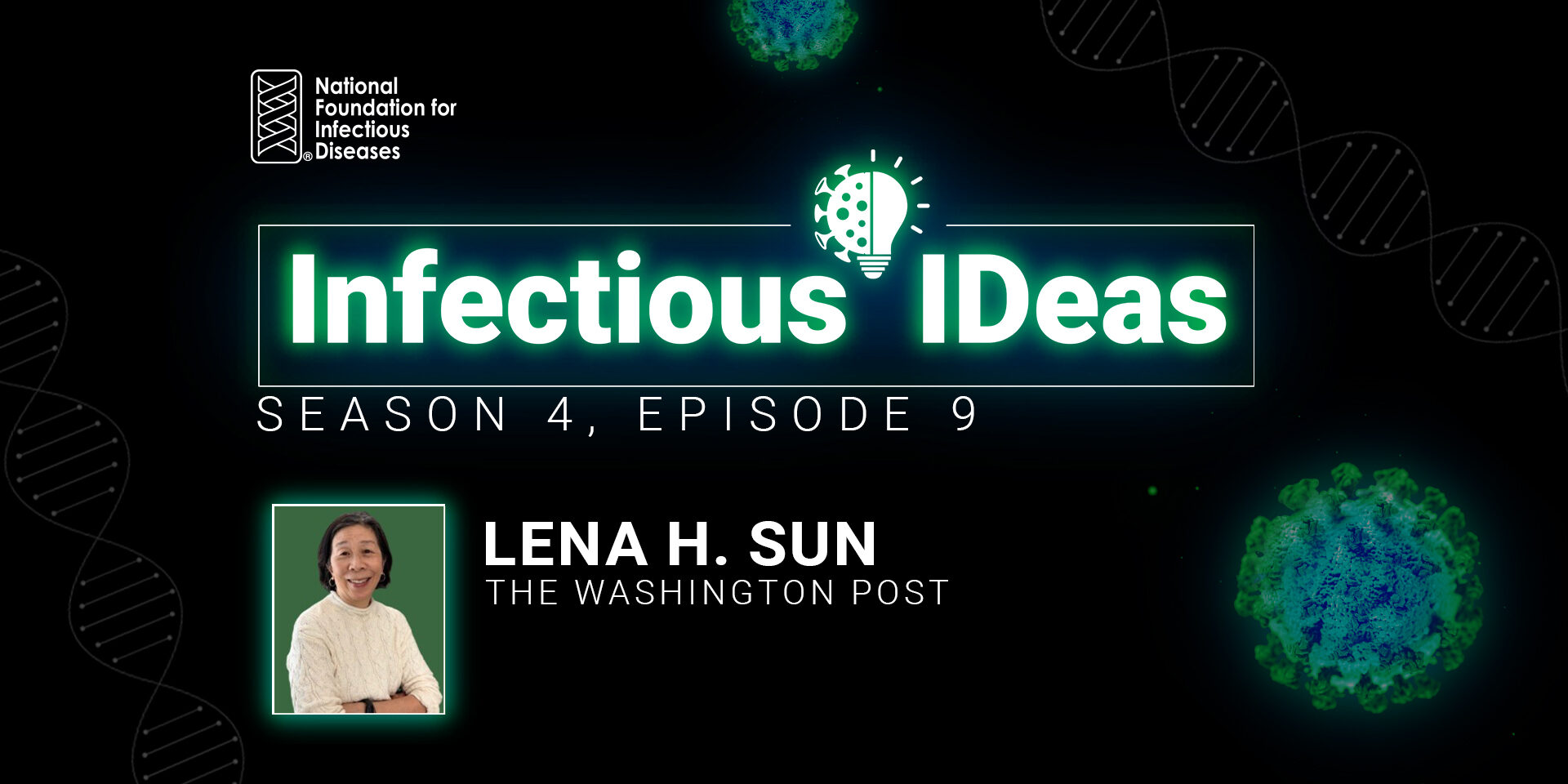
Season 4, Episode 9: How do journalists help the public make sense of complex health issues? In this episode, hosts Rebecca Alvania, PhD, MA, MPH, and Robert H. Hopkins, Jr., MD, talk with veteran health journalist Lena H. Sun of The Washington Post. Drawing on decades of reporting—including front-line coverage of the COVID-19 pandemic—Sun reflects on how the media landscape has changed in the age of social media, misinformation, and artificial intelligence.
The conversation explores the challenges of communicating nuanced science in a polarized environment, what makes experts effective sources for journalists, and why clear, accessible explanations matter more than ever. Sun also shares memorable reporting experiences from global infectious disease investigations and offers her perspective on the future of vaccine confidence, public health trust, and the stories that may shape the next decade. A candid, timely conversation about truth, trust, and the future of public health.
Listen on Apple
Listen on Spotify
Transcript
Alvania:
Welcome to the NFID podcast, Infectious IDeas. This is Rebecca Alvania, NFID CEO, and with me is my co-host, NFID Medical Director, Dr. Bob Hopkins.
Hopkins:
Great to be here with you, Rebecca.
Alvania:
Today we’re joined by Lena Sun, a national health reporter at The Washington Post, who focuses on public health and infectious diseases. Lena is a longtime journalist who’s covered a wide range of beats over her career, including immigration and education, and she’s previously served as the Post Beijing bureau chief. Her reporting has earned numerous honors, including a Pulitzer Prize for national reporting as part of the team covering the war on terrorism and a Robert F Kennedy journalism award for international reporting. Over the years, she’s helped the public make sense of complex and fast moving health issues, often where science, policy, and politics intersect. Lena, thank you so much for joining us.
Sun:
It’s my pleasure to be here. Thank you for having me.
Alvania:
Absolutely. You have spent many years covering public health and infectious diseases. Can you describe a little bit how you got to this beat?
Sun:
I have to say I always wanted to be a doctor because I had this great biology teacher in high school. She was this fierce and funny, no-nonsense person that I think I also had a crush on her teaching assistant, to tell you the truth. But when I went to college, I was very dispirited by my classmates who were also pre-med. And to be honest, I was very afraid of organic chemistry, so I did not pursue that. But once I became a reporter—and the joy of being a reporter is you get to try all different things. You get paid to be nosy. It’s really a wonderful job. There was an opportunity for me to cover health, and so I jumped at it, and that’s how I started.
Alvania:
I think organic chemistry has probably stopped more medical careers than anything else out there.
Sun:
Question I always ask doctors: Exactly, how does organic chemistry actually play a role in your lives now? And it’s zero.
Hopkins:
Very uncommon for certain, and I have to say that organic was almost the end of my medical career as well.
Hopkins:
So, Lena, you’ve had a front row seat to see how much the field has changed over the years. From your vantage point today, what issues feel most consequential in the public health landscape today?
Sun:
I think one of the biggest differences—and we’ve seen this just since before COVID, to now—is how many voices there are inundating the average person through social media, and because of algorithms, and increasingly sophisticated ways to tailor information for that person’s ecosphere. And so, as a result, I think science and things that are close to the truth have a harder time breaking through. And as you know, in science, there’s never an absolute. You can never say absolutely, we know that vaccines don’t cause autism. And I think in this increasingly polarized world, people go to their comfort zone for information, and they don’t want to hear things that don’t represent that worldview, so that even when you are trying to communicate something more nuanced, it’s so much harder. I think that is so clear to me now.
Alvania:
I did a deep dive into all of your headlines to the beginning of the pandemic, and it truly was an experience living it in reverse, but you’ve covered a lot of major stories over the years. So, can you talk a little bit about the story, or a series of stories that you are most proud of?
Sun:
I went back and looked at my stories, and I think because the pandemic left us all with such PTSD, especially those of us who were on the front lines, like the doctors and all the folks in public health, and then us trying to chronicle it in real time.
It was especially traumatic for me, because I remember covering COVID, and my mom had covid, and she died at the beginning of the pandemic. And I remember at the time, we didn’t know that much about transmission. And I just remember so many other people not being able to be with her when she was dying.
But luckily, I had a really good source at the CDC, and I called him the day after to say, Okay, I have to go to the apartment. Is it okay? Will I be safe? And he explained, yes, open the windows. He was just wonderful. So that helped me a lot, but the kind of grief that people were processing during the pandemic was so broad-ranging and intense. Remember when they planted all the white flags down on the mall, and it was such a powerful image. That resonated, because, emotionally, it was very hard to live through that, and I remember writing a story about grief and what it was like to have to deal with all of this. And then my sister died after that, and so it was especially hard. So, I’m not proud of that, but it did leave a very strong scar on my psyche, which I’m sure it has been for millions of Americans.
But in terms of professionally, I feel that some of the stories I did when I went to Africa with CDC scientists to show what scientists on the ground do to figure things out was just so fascinating. It was so much fun to go to the Congo, deep in the forest, reachable only by boat, to see how these biologists were trying to figure out what were the animal reservoirs for monkeypox, which is what it was called back in 2017. And we stayed in a school with tents on the concrete floors. There was a three foot high termite hill in the corner, and we had one meal a day, and I watched them trudge through the forest just to try to figure out this question, and they didn’t really, but how time consuming and carefully all this science is done, and I felt I was able to pull the curtain back a little bit.
The following year, I went with scientists to Uganda, where they were trying to figure out where these Egyptian fruit bats, which are the carriers of Marburg virus—it’s a reservoir—where they would fly to because if you could track the flight path of these bats, then you would be able to do the community work and tell the locals, okay, these bats are coming. Don’t eat those half-eaten mangoes that fall to the ground. And then you pick up a lot of cool things, like as one CDC epidemiologist told me, when you’re looking up in the sky here, don’t open your mouth, because the bats could be flying overhead and they would pee and the virus would get in you.
If there was some small story that I wrote about that brought something to light and caused the government or an institution to remedy the harm that had been done to people, that would be probably more important. But I’ve written so many stories since, none of them stand out.
Alvania:
Those are incredible stories. And I’m going to go home and tell my kids, when you look up at the sky, close your mouth.
Hopkins:
Lena, you’ve written so many incredible stories. I found one again when I was preparing that was a story you’d written about a woman who survived measles encephalitis that really touched me as I was prepping for our discussion today. One thing that has clearly shifted in recent years is the broader, more politicized environment around public health conversations. How do you approach covering science-based policy debates when the political temperature is so high?
Sun:
That is the question for all of us now, and not just for me, anybody who’s working now in this environment, and we just try to go to as many different experts, fact base as we can, and make clear and be as transparent as we can in our reporting.
It’s hard, because the way people are getting their information is different, and what they want to know is also different. And this is one of the lessons, I think, from the pandemic, is that you scientists, public health, folks, doctors, cannot just assume you’re wearing the white coat and say, this study has shown that this vaccine will blah, blah, blah. That is not enough for people, and also, you have to be able to speak in English, and we can get there talk about that. I have a whole spiel about how we do our work and how others can help us, but to be as more fact-based and to explain what it is we know and what we do not know upfront and as much as possible, if we are citing experts say studies have shown blah, blah blah, then provide an online link in the story to that study. So, if you want to go read the study that the Danes did with half a million children, you can look it up. But it is harder, and that is incumbent upon journalists to do their homework more and not just take this side or that side.
But sometimes there is not this dual thing like this side and this side. Vaccines work period, full stop. And I think early on, there was a tendency for media to say, oh, let’s give Andrew Wakefield’s side and let’s give this other side, and it’s not equal. The sky is blue, the Earth is round.
Alvania:
You mentioned something about a minute ago or so about talking to a lot of experts, but can you talk about how you define expertise now people who they trust, who they view as an authority is changing?
Sun:
I think we recognize that there is a greater desire to know more about the science of why, and not just experts say. So, it’s important for us to take that extra step to explain the reasoning and rationale behind health recommendations, for example. And while we look people up to talk to, we want to make as clear as possible if there are conflict of interests and we’re talking to this person or this study, but it was funded by this industry. Because we now have so many more tools to see what kind of studies or journal articles they have authored. In the past, we have tended to focus too much on folks who are older white men, who are the senior people in their jobs. And I try to showcase the younger researchers, women, scientists of color, who often are doing the front-line work and are much more familiar with the data. And it’s nicer to have a fresher voice from a different part of the country for credibility and because they have different experience from the kinds of populations they serve.
Hopkins:
Lena, many of the people listening to this podcast are clinicians, scientists, or public health professionals who are thinking about how to communicate more effectively. What makes someone a particularly helpful source to you as a journalist?
Sun:
Number one, they have to realize that times have changed. We live in a 24/7 news cycle. It used to be when I started my career, way back in the prehistoric era, when dinosaurs still roamed the world, that we had one deadline every day. That’s no longer true, and people’s reading or news digestion habits have changed. You get up in the morning, you scroll through your phone to see what’s going and maybe if in your work, you might at lunch, check the headlines If something comes out at 9 AM you cannot wait to publish a story at the end of the day, so you need to do it immediately, as soon as possible, if not sooner.
That puts a tremendous pressure on journalists, because we would like to be accurate, and I would like to be able to give you the context about why something happens, or why this is important, or why this decision about this vaccine means you will either be able to get it more easily or not, or insurance will cover it—all the context, which takes time.
Most studies in medical journals are not written for the average person. So, for somebody to be a helpful source or helpful expert to me, they have to know the material cold, but most important, they have to be able to explain it to me as if I’m a fifth grader or I’m their neighbor next door and I have no idea what epidemiology involves. Or better yet, I like to tell people you have 15 seconds to explain this to a member of Congress in an elevator. And then somebody who knows all of that is particularly helpful to me, if they are reachable, if I can text them and say I’m on deadline. This has just happened. Could you give me a comment about what this means in the next hour? I need someone who really knows what they’re doing, who understands and how to communicate in English.
Your esteemed colleague, Bill Schaffner, who many journalists go to to get comments, Bill has a great way of putting things in ways that are easy for readers to understand. And I remember one time he was being interviewed by someone about why flu is more dangerous for older folks, and he said something like, the flu is like the lion that is looking for the weak deer or the weak gazelles and preys on them first. You get it right away.
To go to the present day, as the Advisory Committee on Immunization Practices was purged by Health Secretary Robert F Kennedy Jr, and the meetings of the ACIP now are there’s no way to know what’s going to happen because They don’t follow a really rigorous agenda and even when they do, the members often don’t have a good grasp of Robert’s Rules of orders or what the methodology is or the framework for making a decision on a vaccine recommendation. So, anything can happen, and topics will be thrown out for which they may go on for many minutes. And I need someone very quickly to be able to tell me here’s why what they just said is wrong, not that it’s wrong, but here’s why X, Y and Z, or they’re not understanding the space. Having those people basically on call to help me during those meetings is just unbelievably helpful. There are people who have stepped up to help provide that additional background context in real time.
Alvania:
You mentioned how the life and work of reporter has changed because of the way that the information ecosystem has changed. From the reader’s side, how do you think this change, this shift in how people access information, how they find information, whether it’s social media or search or AI? How do you think that has impacted or will impact people’s understanding of health, of science?
Sun:
The big fear is that AI supplants the need to research with this promise of directed, personalized information. So why would somebody read an article about breast cancer screening, for example, when you can ask a chatbot when and why should you get screened? So, we have to recognize that is what people are wanting to know. You can go on Google and see what people are searching for. Invariably, some famous person dies from some disease or something, and searches about that particular tumor or that kind of cancer just go through the roof, and people want to know about it. So, in a way, doing the classic journalism article isn’t enough. If we know that the ACIP, for example, is going to no longer recommend a certain vaccine, then we need to be ready that day if we know that’s happening, or very quickly, to come back with a Q and A or an explainer about, what is this vaccine? What does it do? What are the experts saying about why you should or should not follow this and to be able to communicate it in a very plain-spoken, direct way, because we need to meet readers where they are. If we just go stay in the ivory tower, nobody’s going to read us, and then we will have no impact.
Alvania:
I worked with my son yesterday, just going to the chatbots questions. We thoroughly asked a chatbot about a particular video game that he was trying to best. It gave us this beautiful answer that was 100% wrong. That’s just completely wrong, but it was a wonderful example for him. It’s stated very confidently, yes, but this is not true.
Sun:
That’s good that you did it, because then he learned, right? Oh, I have to be wary about using this information. So, I think that is something we need to be thinking about. And we do think about it when we do our reporting, and we try to think about it for every story we write, to not make it too inside baseball, but to figure out, Okay, what’s the broader takeaway for the average person? How will this affect you, the real person, so that it gives them more meaning.
Hopkins:
So, another dynamic people are watching closely right now is how vaccine guidance is communicated. How do you approach covering health guidance when different institutions or different experts may be sending very different signals?
Sun:
This is the challenge. We do, like we always do, which is by getting as close to the truth as possible and calling many experts from different places, and I’ve done this long enough so that when I’m beginning to hear the same sort of rationale or theory or hypothesis two or three times, then I know that is maybe closer to what more people think, and then we have to be careful about this balance thing and don’t have this false equivalency. And I think we need to make clear that sometimes the loudest noises may be coming from people who are small group, but loud. And just take vaccine, for example. Poll after poll have shown that the majority of Americans support vaccination, including Republicans, and they support the sort of basic vaccines, important childhood vaccines. On COVID it’s very different, but on the basic vaccinations that kids need to get for school, there’s widespread support. And I always have to be careful about not giving too much time to the people who are really outliers and, on the fringe, but represent a very small group of Americans.
Alvania:
We like to ask our guests to look ahead. What do you think is going to be the most consequential public health story that’s going to define the next decade?
Sun:
I don’t know if there’s just one. I don’t know if it will be somehow AI-related, because AI is now creeping into so many parts of our world. Doctors rely on AI to help them come up with the ways they can charge for ICD-10 diagnostic codes, and insurers are also using AI to figure out how to thwart that.
I wonder if it will be vaccines, because we’re in a place now where vaccination rates have dropped so much, and whether vaccine-preventable diseases are going to come back, and it takes time that’s not going to happen overnight, but as you see, the vaccination rates going down for everything and trust in science and public health like in the bottom of the barrel, you wonder what is going to happen, and maybe it will be many more people getting sick, or parents realizing, no, you should not try to get your kid to have measles, because why would you want to risk those complications, which are rare but that do take place?
And if you think about it, COVID and the pandemic led us to exactly where we are in public health right now, the backlash to the pandemic era measures that fueled the rise of the anti-vax movement and swept RFK into his role. That wasn’t the only thing, but there was a lot of that. And you know, there’s going to be another pandemic. We just don’t know when that will take place, and I worry that the kinds of structures and measures that are needed behind the scenes to keep watch and protect Americans are not there or not there in the robust way that we should have.
Hopkins:
So one final rapid-fire question, what one word would you use, Lena, to describe the state of public health today?
Sun:
Maybe it’s not one word, maybe it’s two words. And I think the state of public health today is under assault.
Hopkins:
I absolutely agree with you. More direct face-to-face conversations to get us out of this hole, I think, is what it comes down to.
Hopkins:
We appreciate you spending a little bit of time with us today. We’ve been talking today with Lena Sun, an experienced reporter at the confluence of science, public health, and health. Thank you for helping us to understand and to navigate where all of these things come together to get into the news in the public space.
I want to thank you again for joining us, Lena, and thanks to all for listening to this episode of Infectious Ideas, a podcast series presented by the National Foundation for Infectious Diseases where leading experts join us for thought-provoking conversations that lead us to infectious ideas. Be sure to subscribe to the podcast on Apple, Spotify, or wherever you listen to your favorite podcasts. If you’d like more information about NFID, be sure to visit us online at nfid.org. Until next time, stay safe, stay healthy, and get vaccinated.