
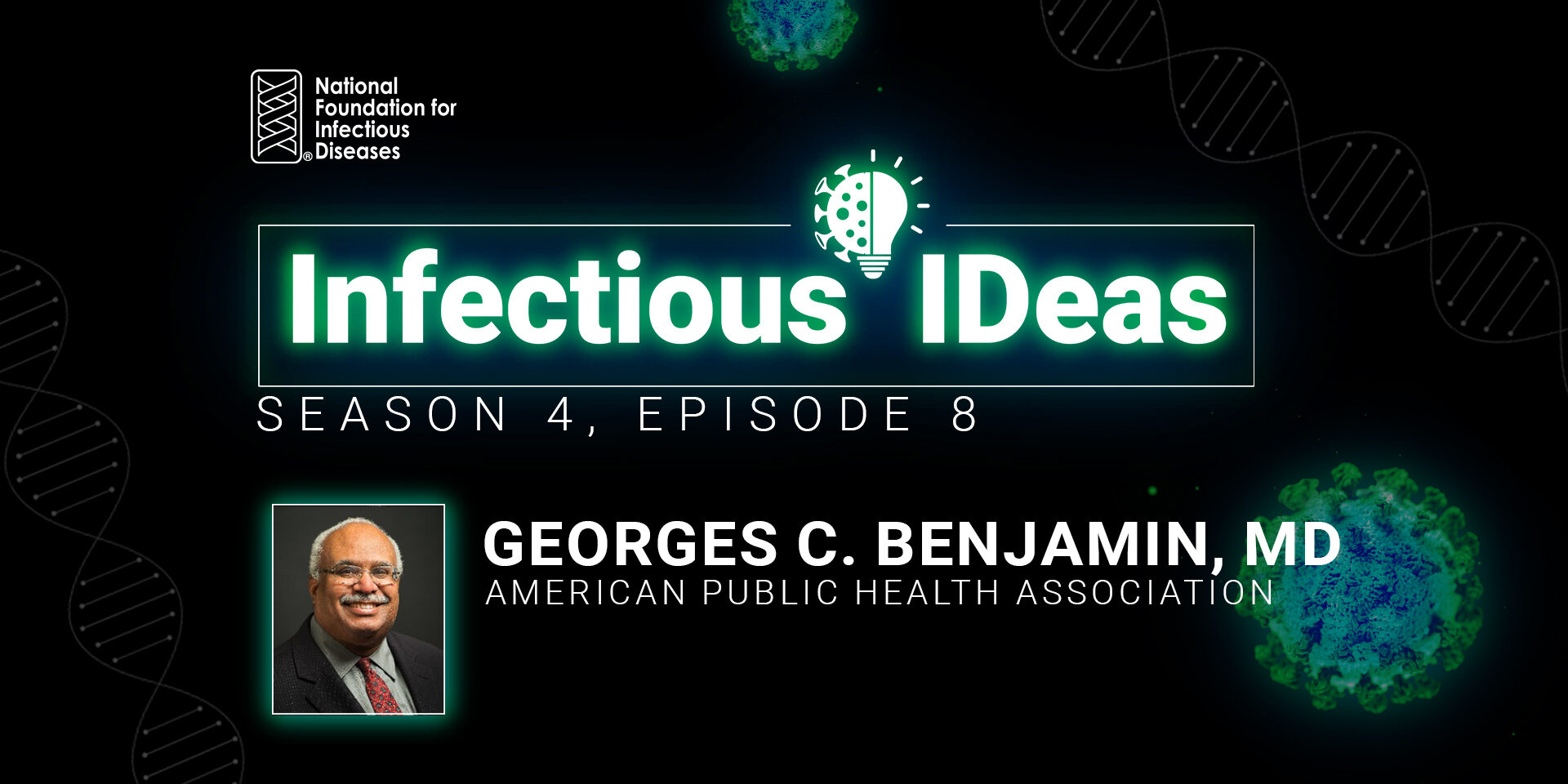
Season 4, Episode 8: How does a career in the ER lead to shaping national public health leadership? In this episode, hosts Rebecca Alvania, PhD, MA, MPH, and Robert H. Hopkins, Jr., MD, talk with Georges C. Benjamin, MD, executive director of the American Public Health Association. Drawing on decades of experience at the intersection of medicine, policy, and community health, Benjamin explains why trust is built through relationships, transparency, and consistent action over time. The conversation explores misinformation and “alternative facts,” communicating prevention more effectively, strengthening community engagement, rebuilding public health systems, and preparing the next generation of the workforce.
As APHA’s leader since 2002, Benjamin has championed prevention, health equity, and strong public health systems nationwide. A board-certified internist and respected voice in public health leadership, he previously served as Maryland’s health secretary and has held clinical, academic, and military medical roles. Benjamin has authored more than 200 publications and is widely recognized for his expertise in preparedness, policy, and population health—bringing decades of real-world insight to conversations about protecting communities.
Listen on Apple
Listen on Spotify
Transcript
Alvania:
Welcome to the NFID podcast, Infectious IDeas. This is Rebecca Alvania, NFID CEO. And with me is my co-host, NFID medical director Dr. Bob Hopkins.
Today’s guest is one of our most respected voices in public health in the US. Dr. Georges Benjamin is executive director of the American Public Health Association. He’s a longtime leader, known for his passionate advocacy on the health issues that most impact our nation. Over the course of his career, he’s served as a public health official, a physician and advocate, and national spokesperson for science-based policy. He’s helped shape how the country thinks about prevention, preparedness, equity, and trust in public health institutions. At a moment when public health faces both unprecedented challenges and opportunities for renewal, Dr. Benjamin brings a perspective that’s grounded in experience and a deep commitment to communities. We’re excited to talk with him about where public health goes next and what it takes to create a more resilient and equitable public health system for the future. Georges, we’re so glad to have you here.
Benjamin:
Thank you very much for having me.
Alvania:
You started out in clinical medicine, including working as an ER doctor, and then you made the move into public health. So, can you talk about that transition and what made you want to move from individual patient care to public health?
Benjamin:
I had been in medical management since I left my residency. I literally got into being a director of a large ambulatory care program within the Department of Emergency Medicine and Madigan Army Medical Center. So, I’ve been doing health administration very early on, right after finishing my residency.
So I spent the first half of my career functionally practicing emergency medicine and being a health administrator with that vein in mind, and then was sitting at my desk at the city hospital, DC General Hospital in Washington, DC, one day, and my phone rang, and it was the mayor on the other end of the phone, who said, Have I got a job for you? And we had talked at one point about me maybe being a Deputy Fire Chief and running the EMS system. But on that particular day, he needed someone to replace the health commissioner who was stepping down, and so I ended up becoming a health commissioner. And I got to tell you, I thought of it as being a medical director of health for the city. In many ways, I saw it as following the traditional path. And then, of course, when I got over to the Health Department, which I knew reasonably well, they had this pesky little stuff called public health as part of the department. And of course, despite the fact that we had a couple of nursing homes and all the community-based clinics, the truth of the matter is, 95% of my day was doing public health and public health policy. So, I became the chief health strategist in Washington, DC, and that’s how I got started.
Hopkins:
Well, Georges, you’ve spent many years at the intersection between public health policy and practice, as we look at today’s public health landscape, what concerns you most, and what gives you the most hope going forward?
Benjamin:
What concerns me the most is enough people are accepting the concept of alternative facts. And of course, there’s no such thing as alternative facts. Facts are facts.
What certainly gives me hope is the recognition that nobody wants to do something that’s going to make them worse. People—even though they may debate about what is true—don’t want to do things that are going to hurt them. Now, unfortunately, because of disinformation and misinformation, far too often, people are driven to do things that they think are going to make them healthier or safer, but it turns out they’re the wrong things. What gives me hope is the fact that they’re on the quest for health, and that gives us an opportunity to do things differently, I think.
Alvania:
You have played a leadership role in so many different areas of health. So, when you reflect on your career, and maybe particularly your time in leadership, what are some of the things that you are most proud of, and then on the flip side to that, what are some situations that have really challenged you as a leader?
Benjamin:
I’ve been extremely fortunate that I’ve been able to identify an amazing ray of very competent, talented people wherever I’ve gone, and then I every now and then found a diamond in the rough within the institution. And I think the thing that I’ve been most successful at is giving those people the space to really shine and do their best work. And I really do believe in trying to find the best people that I can, pointing them in the direction that I think we need to go, and getting out of their way to let them accomplish those goals.
And I’ve also been relatively successful in finding people that will pull me aside when I’m about to do something stupid and at least limit my capacity to do that. And I’m very capable of doing the wrong thing, but I’ve been very comfortable with finding really good people that have helped me chart a good path forward.
Hopkins:
Obviously, these days, public health is operating in a highly politicized environment, and those missteps often make it amplified because of that environment. How can leaders advocate effectively for science-based policies while navigating those political realities?
Benjamin:
We always tell people to follow the science, and we treat that as though that is the goal. And I do think we need to rebase our conversation there.
Science is an interview process, and science is really the quest for truth. And what we should be telling people is we’re trying to find out what the truth is, what the facts are, and that our scientific process is one where we think we know what’s going on. We question why we want to understand something. We study it. We get the best information that we can. We work with that information to, in our case, try to improve the health of the population, to get the best answers that we can, and then we continue to question that, is that the best we know? And then in that circular process, eventually we get to the preponderance of the evidence, which at least for that given day, we would call the truth.
And one day we’ll get there. But we shouldn’t tell people with such certainty that what I’m telling you today is real, because what I’m telling you today is the best that I know, and this is the best advice I can give you based on what I know. But you should know that I may come back an hour, a week, or a month later, sometimes years later, and say that there’s new stuff that we’ve learned that changes my advice to you. I think if we can get both the public to understand that, and of course, our colleagues to behave in that manner when they’re articulating what they’re doing, and as we do our scientific process, I think we’ll all be better off.
Hopkins:
The humility to admit that this is what we know now and may not be what we know in the future. The malleability is something we have to recognize from the start.
Benjamin:
That’s right, and that many people come to that perspective with different levels of knowledge, and we should not assume that because somebody has a lower level of what we perceive as knowledge doesn’t mean that their concept of where we’re going is not closer to the truth than we are.
Alvania:
So, we’re talking about communication. Let’s talk about communication specifically related to prevention for a moment, which is obviously so core to public health. But it feels like it’s getting harder these days to communicate why prevention matters. I think we’re seeing that play out a bit with things like the measles outbreak, right? So, some people are tired, some are skeptical, some feel like the system hasn’t always worked for them. How do we talk about prevention in a way that really connects with communities today?
Benjamin:
We often talk about the fact that we’re talking about prevention, but I’m not quite sure that we are really selling prevention as the best buy that it is in the best way possible.
First of all, of course, when we do our best work, nothing happens, or the less severe things happen. And if you think about what we did during COVID for a variety of reasons, we were counting ER visits, hospitalizations, and deaths, when we probably should have been talking about lives saved, lives improved, number of people vaccinated, and helping people connect the dots to our prevention efforts, versus, frankly, being on the frightening side of the equation, which they were already afraid of the disease. Now it was important for us to tell people what we knew and what we didn’t know, but we often did not celebrate successes on an ongoing basis, which I think would have been much more helpful.
The other thing that we’ve allowed to happen is we’ve allowed our political leaders to politicize things that should never have been politicized. And we didn’t call them out on it, and we should have done that, and we should not have made it easy to walk away from a health official and make it acceptable for people to bully health officials during that outbreak.
We always knew that the tradeoff between our health and the economy was going to be a central tenet of any major disease outbreak. And yet we really have not honed down the messaging. The best way to economic stability and economic recovery is to focus on health.
If we really got ahead of that message by pre-bunking a lot of the stuff that, quite frankly, we knew was going to happen, we would have been better off. But we didn’t, and so now we’re playing clean up. Those of us who are in the public health community have done a terrible job of engaging the community, because what you had in a lot of our communities was an unknown public official. Health official may have been there for years, but nobody knew who they were, with unknown police powers now telling people, you had to take a mask, you had to get a shot, you had to stay home. And in those communities that had a stronger relationship with the health official, just like they may have with the police commissioner, the fire department director, the school superintendent, to the extent they have a better understanding of who they are, what they’re there for, and have a trusted relationship with them, the more likely those communities were to follow the best guidance that they had at the time, and to say the guidance is changing, and here’s why, trust me.
When we didn’t have that relationship, then it was easy for people to demonize those officials or for the political figures to walk away from them.
Hopkins:
It really makes a difference walking the walk with people and sitting with them, talking with them eye to eye.
Benjamin:
Yep, absolutely.
Hopkins:
So public confidence in science and public health has been tested in recent years. What gives you optimism and where do you see the greatest opportunity for us to rebuild trust?
Benjamin:
Trust is easy to lose and hard to gain, I think we need to be very careful about people who are offering us quick fixes. Who are saying that if we do A, B, C, and D, if we talk a little differently about this, all these kinds of things will rebuild trust. Those may be technically true, that if you talk to people differently and use different words, you rebuild trust. But at the end of the day, trust develops when people know you, they have a relationship with you where they don’t assign ulterior motives to what you’re recommending that they do, where you do what you say you’re going to do, and they see that you walk the talk and that you do it all the time, that you’re human, and you might make a mistake, but that when you make a mistake, you own up to it, you do whatever you can do to correct it, and then you move on. So, at the end of the day, again, the preponderance of their experience with you is that they can trust what you say., they can trust what you do.
Alvania:
We’d like to take a quick break from Infectious IDeas to talk about the important work of the National Foundation for Infectious Diseases. NFID remains dedicated to providing trusted evidence-based information to protect public health and empower individuals to make good decisions about their health. But we can’t do it alone. Your support helps us address misinformation by sharing reliable resources to keep individuals, families, and communities safe from preventable diseases. Visit nfid.org, forward slash, donate to make a difference today. Together, we can ensure everyone has access to the facts they need to stay healthy.
Alvania:
We’ve talked a lot about the challenges that public health is facing right now, and I think that for a lot of people, it can feel like we’re moving backwards in some really important areas. When you think about where public health is today, what are some areas where you think we could achieve important wins in the next five to 10 years?
Benjamin:
There is no question that public health and our health systems overall are under attack, and they’re under attack for a variety of reasons. In some cases, the fact that we have allowed our nation to have the person as our chief health strategist who’s really not qualified to be there. So I think one of the things we have to do as we go forward is make sure that we put people who are in the job as our chief health strategist, that are people that are skilled and competent and trained and have the capacity to do those jobs, both on the management side, and who believe in evidence-based decision making, who believe in community engagement and really walk that talk. That’s the first thing we ought to do.
The second thing we ought to do, of course, is reimagine our systems going forward. None of our systems were perfect. In fact, we’re spending over $5 trillion on health in our country, and we’re getting the worst outcomes we could possibly get, compared to other industrialized nations and other nations with resources. So, the first thing is reimagining the future, and then building to that reimagined future, versus trying to fix and patchwork broken systems.
We need to get the universal coverage for everybody, while 80% of what makes you healthy occurs outside the doctor’s office, that 20% you need, and we need to make sure everybody can get into that system and have a system that meets the needs for everyone through whatever model we choose, but to have universal coverage, absolutely need to have that. I’m not making a single-payer statement. I’m taking a system with everyone in and nobody out. If it’s single-payer, great. If it’s not single payer, there are other models that can get us there.
Second thing I’m thinking we should do is to build a sound health information data highway. Every other industry has figured out how to use technology to pay people right away, to limit fraud and abuse, and to share data. We still have many systems that cannot simply move an EKG across the street. We’re still data archeologists. Much of the data, even in our nation’s premier prevention agency, CDC, the data they sometimes get is months and weeks, sometimes years old. It’s unfortunate, and yet nobody else operates in such a data-driven, delayed system. The technology is there, other nations have built that, and for once and for all, we need to build that system and put the incentives in the right place, so that we cannot have health departments sending information around the country by fax machine.
We need to think about the future of our health workforce and reimagine the skill sets that we need for that health workforce, and we need to strengthen the pipelines, so we have a diverse, highly skilled, competent workforce.
Finally, we need to realize we’re in a globalized world. We’re not by ourselves, and that reimagined future that we need to have for public health has got to recognize that we’re the only nation in the world that separates the healthcare system from the public health system. We need a unified health system that can make sure that everybody can achieve optimal health, and we need to design the system to get there. And I think we have a lot of really smart people in our country, and we can figure it out. And it’s not rocket science. A lot of the solutions are in front of us. We have just not had the political will to do it.
Hopkins:
Our public health workforce is really under strain. What do we need to change to recruit, to support, and retain that next generation of public health professionals?
Benjamin:
We have to show them that public health and public health practice is exciting. I’ve learned a lot about prevention and how it can be an extraordinary tool, and I think we have to figure out new ways to make that exciting. Now we do have to address some of the salary issues. There are real salary issues here, we have to address the ability for students to go to school and make this education affordable. We need to figure out ways to make that exciting to people.
I, like many of you, are mourning the loss of Bill Foege, who just recently passed away. Bill was, in many ways, along with others, the heart and soul of the polio eradication effort, a strong figure at CDC, but he tells a story about him having to sneak into another country’s vaccine depot to confiscate vaccine, and he tells that story of his miraculous escape in order to get the vaccine so that they could continue the vaccine polio eradication effort. Boy, what an exciting story.
And we’ve got lots of people with those stories in public health. I can easily see a TV series like the CSIS series or ER or pick a television story that tells the story of public health in these amazing ways, the number of people who have done detective work to find new diseases. The HIV/AIDS story is a terrible disease, but its evolution is a wonderful detective story. And public health, our stories are not being told like they ought to be.
Alvania:
In your role at APHA, you really see the full landscape of the field. So, when you think about the future of public health, what keeps you up at night?
Benjamin:
There’s not been a year, frankly, in my experience, that we’ve not had a public health emergency of some kind, some smaller than others, and there’s a range of nightmare scenarios. We’re all waiting for the big one in terms of an infectious disease. But we have some natural disasters. Can you imagine, particularly with climate change, that we have a major freeze in the south of our nation? Imagine one of those where the southern grid totally goes out, and we’re set up for that, where we have a major blackout, a loss of power in a major region of our nation. Just trickle down all of the bad things that could happen if that happened. So, it certainly isn’t one threat. There are infectious threats, environmental threats, and biosafety threats due to genetic manipulations. There’s so many things that can hit us.
And of course, my nightmare is that we as a society, because of many of the things that are happening right now at the national level, have become blind because of our barriers to our data systems and our surveillance systems. We won’t know until we’re way behind the curve, when that new health threat enters the community, and then our capacity to organize and address it will be crippled, because we have undermined the basic public health system we have in our country. In only a year, we’ve crippled it, and that scares me, because if something happens right now, we’re in trouble. We’re in really big trouble. This nation has the capacity to pick ourselves up and address it, but it’s going to be painful, and that really keeps me up at night.
Hopkins:
Georges, if you could bust one myth about science or public health, what myth would you bust?
Benjamin:
The myth that public health is only for people who are underserved and poor people. This view that it doesn’t protect us all. If we could get everybody in our society to understand that public health is for everybody and not for just a few—or for me, if something bad happens to me—that would help build the social solidarity that our society needs to move towards.
Alvania:
Some of our listeners don’t necessarily work in the public health field, but they care about public health. They care about their communities. So, if you’re speaking to them, what’s one simple action that they can take to make a positive difference?
Benjamin:
Get to know their elected officials, whether they’re talking about the homeowners’ association or the people in the school board, or their state elected officials, city, county elected officials, certainly their federal elected officials. Just get to know them. Whatever your expertise is—education or engineering or science or mathematics or childcare—get to know them, so that when you want to give them your advice, they not only see you as a constituent, but they see you as a trusted voice in your community. And then when an issue that is relevant to the health and well-being of your community occurs, you’ve already got the relationship set up so that you can speak out on it. And then, of course, what I would like you to do is speak out on it and realize that there is public health in everything that we do, whether it’s education or transportation or housing, it’s not just medical care and having those relationships before we need our elected officials who, by the way, work for us will help build again the social solidarity that our communities are losing.
Hopkins:
What’s something people would be surprised to learn about you, and what do you like to do for fun?
Benjamin:
My younger years, I was a skinny kid. I was a musician. I played trombone, I played baritone horn, and I marched in a national championship drum and bugle corps, the Vanguard Drum and Bugle Corps, Des Plaines, Illinois. I did that through my adolescence and early parts of my college. I still have a trombone and a baritone horn at home, and I pull them out every now and then. I’m not very good anymore, but I make noise with my horn every now and then. And I love music. I love all kinds of music.
Hopkins:
We’ve been talking today with Dr. Georges Benjamin, a physician, public health leader, and an advocate for all of us. Thanks again for joining us, Georges, and thanks to all for listening to this episode of Infectious IDeas, a podcast series presented by the National Foundation for Infectious Diseases, where leading experts join us for thought-provoking conversations that lead to infectious ideas. Be sure to subscribe to the podcast on Apple, Spotify, or wherever you listen to your favorite podcasts. And if you’d like more information about NFID, be sure to visit us online at nfid.org. Until next time, stay safe, stay healthy, and get vaccinated.