
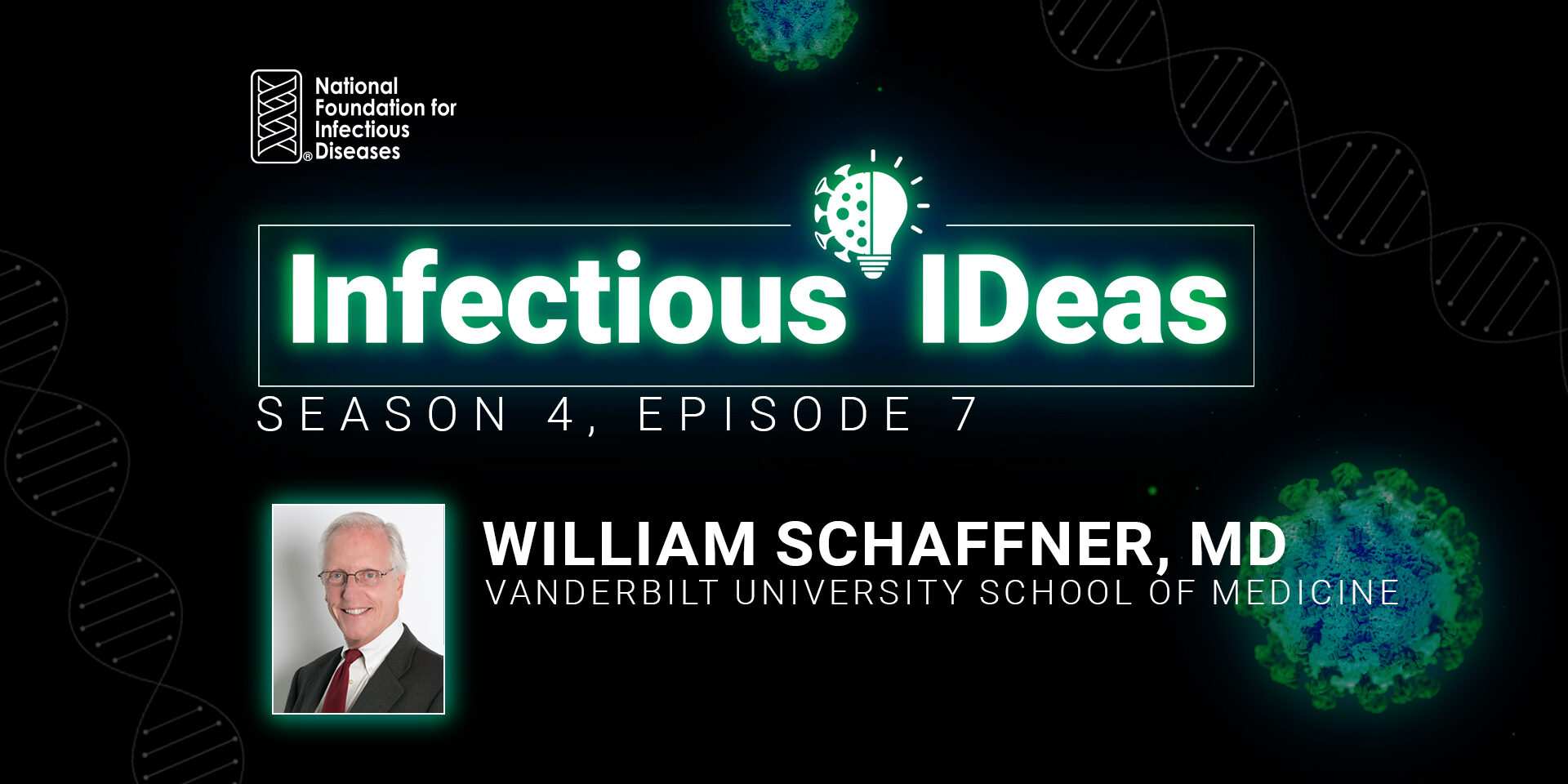
Season 4, Episode 7: How do we rebuild trust in vaccines and public health—and why aren’t facts alone enough? In this episode, hosts Rebecca Alvania, PhD, MA, MPH, and Robert H. Hopkins, Jr., MD, talk with infectious disease expert William Schaffner, MD, about vaccine confidence, public trust, and the growing impact of misinformation. Drawing on decades of experience, Schaffner explains why effective science communication must reach hearts as well as minds to change behavior. The conversation explores vaccine hesitancy, social media’s role in shaping beliefs, the importance of listening to patients, and why public health education must start early. A thoughtful discussion for clinicians, public health professionals, and anyone concerned about the future of prevention.
A longtime advocate for disease prevention, Schaffner is a trusted science communicator whose clarity, perspective, and calm guidance have helped shape public health conversations for decades. He is a professor of Preventive Medicine and Infectious Diseases at Vanderbilt University School of Medicine, and he has worked extensively on the effective use of vaccines in adult populations. He previously served as NFID president, medical director, liaison to the Centers for Disease Control and Prevention Advisory Committee on Immunization Practices, and host of the NFID podcast. In 2013, NFID honored him with the John P. Utz Leadership Award in recognition of his extraordinary service to NFID and the infectious disease community.
Listen on Apple
Listen on Spotify
Transcript
Alvania:
Welcome to the NFID podcast, Infectious IDeas. This is Rebecca Alvania, NFID CEO. And with me is my co-host, NFID Medical Director, Dr. Bob Hopkins.
Hopkins:
It’s great to be here, Rebecca.
Alvania:
Today, we’re very happy to welcome back a familiar voice to the podcast, Dr. William Schaffner. Dr. Schaffner is a nationally recognized infectious disease expert and educator. He’s also a longtime advocate for preventing vaccine-preventable diseases. Many of our listeners will remember him as a former co-host of this podcast, and many know him as a trusted science communicator. His clarity, perspective, and calm guidance have helped shape some of the most important public health conversations of our time.
Over the years, Dr. Schaffner has worn many hats at NFID. He has served as our president, he’s been our medical director, and he’s acted as our liaison to the CDC Advisory Committee on Immunization Practices. He’s also a professor of Preventive Medicine and Infectious Diseases at Vanderbilt University School of Medicine. Much of his work has focused on improving how vaccines are used in adult populations. In 2013, NFID honored him with the John P. Utz Leadership Award. That award recognized his extraordinary service to NFID and to the infectious disease community. We’re so glad to have him back with us today to talk about where we’ve been as a field and where public health and science communication may be headed next.
Bill, welcome back to Infectious IDeas, this time on the other side of the microphone. Thanks so much for being here. Let’s start at the beginning. What first sparked your interest in disease prevention and public health?
Schaffner:
Well, first, thank you, Rebecca and Bob, for inviting me. This is a pleasure, but as you say, on the other side of the microphone. As I thought about what sparked my interest in prevention and public health, I think I would mention two things. The first seems rather unlikely. Back in the day, when I went to medical school, we had summers off, and many of us tried to do something in the medical field to make a few dollars, but also to gain experience that we would not have had in medical school. And it’s another kind of cute story, but I actually talked myself into a research project that was run by one of the faculty at Cornell Medical School, where I was. He sent a team to Mexico to study traveler’s diarrhea. And to make a long story short, I was the youngest member of the team, and so, understandably, I was given the job of taking, if you will, stool specimens and dividing them into several portions and putting them in the appropriate containers. Thereupon began my interest in medical research, in infectious diseases, in global medicine, and in preventive medicine. So that was a very unlikely beginning.
The other is that, as a consequence of that, to fulfill my selective service obligation, I inveigled an application to the Epidemic Intelligence Service, that training program at the CDC. I was an EIS officer and was assigned to the state health department in Rhode Island, where I got involved as an internist who had been trained in bacterial diseases, their diagnosis, and therapy. I got involved in preventing measles, a viral infection, by implementing a vaccine in a large population. And my interest in prevention and public health—things that happened before patients were admitted to the hospital—just blossomed. And like Topsy, it’s grown ever since.
Hopkins:
Wow, Bill, those are both important stories. I’m just glad you didn’t finish the first part with you ended up with that traveler’s diarrhea as sine qua non.
Schaffner:
Oh, I’ve had several of those episodes, but we don’t need to go there now.
Alvania:
That’s where I thought it was going as well.
Hopkins:
So, Bill, what stands out as your proudest accomplishment as you look back over your career?
Schaffner:
I think working with trainees—infection disease fellows, EIS officers. EIS officers are assigned to state health departments or at the CDC, and Tennessee has a long history of providing a wonderful training ground for EIS officers. And I have a long association with the Tennessee Department of Health, and I’ve been able to co-mentor EIS officers now over many decades. And working with young people—medical students, fellows, EIS trainees, the Epidemic Intelligence Service officers—seeing their careers flourish and as they go on and make contributions beyond, I think that’s still something I do and is heartwarming.
Now, I’ve been asked occasionally, what’s my favorite paper contribution? And now I may surprise you. With an EIS officer, a fellow by the name of Mike Decker—he was the EIS officer—he and I and others actually investigated the impact of child restraint devices, that is, child car seats, in reducing injuries and child deaths in car crashes. Tennessee was the first state in the country to have such a law. Mike’s study was a brilliant demonstration of how favorably impactful child restraint devices were, starting with that very first ride from the hospital—may the first ride be a safe ride. And that paper, published in JAMA, had ripple effects. It was often cited in other legislative hearings across the country. Mike and a state senator often attended those meetings and gave testimony. So, it catalyzed the passage of such laws across the United States, saving countless children from injuries and deaths due to car crashes. That’s a gift that keeps on giving absolutely every day. It’s not infectious disease, but it’s my proudest accomplishment.
Alvania:
We’re going to stick with the theme of looking back and reflection. Was there a moment in your career that really tested you or really challenged you, and if so, what was that like?
Schaffner:
I must say, I’ve been extraordinarily fortunate. I came from Cornell here to Vanderbilt to do my house staff training. And as I like to say, they haven’t gotten rid of me yet. And so here I am. I haven’t had any major challenges. But professionally, I think the biggest challenge came when, in the mid-1980s, we had a surgeon in town who was identified as having AIDS. He was publicly known, so confidentiality was not an issue. And again, with an EIS officer, Ban Mishu Allos, we conducted a look-back investigation and demonstrated that surgeon had been essentially of no risk to his patients. And that was a major issue at the time, and we had to overcome many local hurdles and barriers to doing that investigation. She did a superb job. And I think of all the challenges that have come up occasionally in my life, that was one of the ones that had the most impact. The country was on the verge of making a requirement for all surgeons to be periodically tested for HIV. Once that paper came out, that issue was set aside.
Again, an investigation by an EIS officer that had large implications for public health and prevention, in the sense that it was an intervention that had been suggested but really wasn’t needed.
Hopkins:
It’s the unexpected result that drives so many of us as we think forward. As we think about vaccines to emerging pathogens, what infectious disease threats do you think remain underappreciated right now, Bill? And why should we and other audiences pay closer attention?
Schaffner:
Bob, you’ve just heard me sigh, because you know that vaccines are, I think it’s fair to say, under attack—not just underappreciated, but under attack—in this country. And I would put that at the top of the list at the moment.
But stepping back a little bit and looking at some larger issues, I think it’s underappreciated generally by our political leadership, as well as the general public, that endemics and pandemics are part of our life, and we need to prepare for them. I think public health as a discipline is underappreciated. The salaries are not that great. You really have to be committed to go into public health. And I think our medical schools do not give public health the exposure it deserves. Public health is the first line of defense, not just in our own institutions, our own communities, our own states, but nationally and internationally. What’s over there can be over here. It’s just an airline away. Those viruses don’t need passports. So, I think that interrelatedness of the world’s population and its capacity to share pathogens is not appreciated.
Alvania:
In addition to some of the scientific contributions, Bill, that you’ve talked about, that you’ve made throughout your career, you’ve also spent a lot of your career explaining complex science to many different audiences. What do you think has changed the most in how people receive that information today and how much they trust it?
Schaffner:
Rebecca, that’s a terrific challenge. First, because of everything that’s happened in the last years or so, trust in public health authorities has really diminished. There’s an epidemic of skepticism that’s out there. And because CDC’s expertise has essentially been hollowed out, it will take a long time at the federal level—and those of us at the local level—to try to restore that. When I say a long time, I mean years, and it will take a lot of work.
Some of the things that have changed, of course, are social media. I started talking to newspapers and TV stations, but now we have social media that are out there. Everything is faster, and everyone’s their own reporter, and misinformation travels very rapidly. Also, let me say that we as a public health structure in this country, at the local, state, and federal level, really haven’t been able to engage with social media in a sufficiently effective way. We’re frequently responsive—and slowly responsive—whereas we have to get ahead of these stories. I have to pass that baton on to the next generation, those now 8-year-olds who are going to be so savvy going into the future, and I ask for their help.
The other thing I would say is that coming out of the scientific tradition of medicine, we often try to overload our communications with facts. It’s as though we’re giving mini lectures in medical school to our patients. The behavioral psychologists have told us that facts are foundational, but what changes behavior is what they call attitude. It’s not so much what individuals think. It’s how they feel. And how can we make our messages, how can we parse them, so that people are more comfortable and reassured? How can we reach their hearts as well as their minds? That’s something I struggle with, and we’re all going to have to get better at in order to mold that behavior, because public health is in the business of molding behavior so that health is improved.
Alvania:
We’d like to take a quick break from Infectious IDeas to talk about the important work of the National Foundation for Infectious Diseases. NFID remains dedicated to providing trusted, evidence-based information to protect public health and empower individuals to make good decisions about their health. But we can’t do it alone. Your support helps us address misinformation by sharing reliable resources to keep individuals, families, and communities safe from preventable diseases. Visit nfid.org, forward slash, donate to make a difference today. Together, we can ensure everyone has access to the facts they need to stay healthy.
Alvania:
Today, I think a lot of people would describe our environment as polarized. I think that impacts sometimes for the busy clinician or health professional, the topics that they want to bring up with their patients and how they approach those topics. Do you have any lessons learned or recommendations for healthcare professionals and how they speak to their patients, to reach the hearts and not just the minds, specifically in this type of environment?
Schaffner:
Yes, I think medicine, speaking large, has learned that lesson, and medical schools now are formally putting communications in their curricula and training students how to, as my mother would say, shut your mouth and open your ears. Listen to your patients, and then giving medical students the techniques to validate their patients’ queries, how to answer them in a way that does make them comfortable and reassured and more accepting of whatever guidance we wish to provide. Medical students today are better trained than they were. That was never part of our curriculum, it was assumed that we all would know how to communicate. We’re much more sophisticated today, and I’m guardedly optimistic that the current students, who are as wonderfully devoted to doing good things, will be more skilled in actually communicating with their patients.
And I always say, talk to your doctor, have that conversation, ask those questions, because those doctors, those healthcare providers, are there to take care of you and your children on a daily, weekly, monthly, yearly basis. You can trust them.
Alvania:
And I think, close your mouth and open your ears is good advice for many of them.
Hopkins:
And sometimes it’s challenging.
Schaffner:
Yes, indeed.
Hopkins:
So, Bill, vaccines remain one of our most powerful public health tools. What scientific advances or policy shifts, do you think could most meaningfully improve vaccine uptake and impact in these next few years?
Schaffner:
Oh, Bob, that’s the most difficult question, because we’re actually at a sad, deeply concerning moment. It would appear that the federal leadership, and you know what, I don’t go into politics, but this has to be acknowledged, the federal leadership is turning back the clock to the bad old days, not supporting vaccines, indeed, pulling back the support and affirmation of the importance of vaccines, and I am very concerned that we are moving back to the bad old days. Measles, being first and foremost, because it’s the most contagious of these illnesses, will begin to spread once again in our populations, and we’re going to have to expand our curricula to tell our medical students about these illnesses.
Incidentally, let me get off on a hobby horse for just a moment. We have defined vaccine hesitancy, skepticism, and indeed, anti-vaccine as a medical and public health problem. Of course it is, but I’m going to suggest it’s also an education problem. If we look back at the health curriculum of middle and high schoolers, we would see very little taught about vaccines and vaccine-preventable diseases, those of yesteryear, polio, diphtheria, et cetera. Big surprise then that the graduates of our high schools in a few years are parents, and they have a lot of questions about vaccines.
I think we need to broaden our interest from our medical professional view of this, and work much more intensively with educators. If the three of us did a study and just picked out high school graduates at commencement randomly across the country and asked them two simple questions: What’s a vaccine? How does a vaccine work? I think we’d get a lot of [mumbling]. I don’t think we would get simple declarative answers. Oh, are vaccines something you take in order to prevent a disease. How does it work? Oh, it stimulates the immune system so it’s better prepared in case you’re exposed. Those are very simple concepts, but I suspect the majority of high school graduates couldn’t give us those simple answers.
Alvania:
We’ve touched on education. We’ve also talked about public trust in science, and we know that public trust in science has been shaken in recent years. So, when you look ahead, what do you think is the biggest opportunity for us to rebuild trust in public health and infectious disease?
Schaffner:
Yeah, Rebecca, it’s a long haul in doing many things to the best of our ability, just each of us when we have opportunities to work communicating through the media, to give good information, and again, try to reassure our listeners, and then all of us, as we take care of patients, doing that one at a time. It will take a long time to rebuild the public health infrastructure and trust. I don’t think there’s an easy way to do this.
Hopkins:
Bill, let’s go back to education. You’ve mentored generations of infectious disease leaders. If you could offer one piece of advice to the next generation of infectious disease clinicians and communicators, what would it be?
Schaffner:
I would just say, stay the course, keep smiling. You’re on the side of the right and the good. Be sustained and continue to have courage and move forward. And in whatever arena you are active—in your own little practice, in your local medical society, wherever you are—keep on advocating for the good and the right.
Hopkins:
I think that’s so important—the smile on the face—that is becoming a bit more challenging at times, but both of those are so important for us to engage. And having that respectful engagement, I think, is so critical for all of us.
Alvania:
We’ve touched on some of the current challenges that we’re facing. What worries you the most, and then what gives you the most hope?
Schaffner:
What worries me the most, of course, is what’s happening at the present time, the hollowing out of public health, the withdrawal of funds for medical research, all of those terrible things. That’s something we’re going to have to endure, and I hope in the future, restore. The restoration will take a long time.
What gives me the most hope is my contact with medical students, residents, infectious disease fellows, EIS officers, they just glow with wanting to do the right thing. They are as dedicated as we all were back in the day. And so, we’re recruiting wonderful people into medicine, and they are the hope for the next generation.
Alvania:
That’s wonderful. It’s such a common answer that it’s the next generation that gives us hope across disciplines.
Schaffner:
Yes.
Hopkins:
What’s something that people would be surprised to learn about you? What do you like to do for fun?
Schaffner:
Here’s a surprise. I bet you don’t know this. I am very closely associated, now a member of the board of the Elephant Sanctuary in Tennessee. It’s a 30-year nonprofit that takes in abused, unwanted, ill elephants and restores them to a more natural environment. I began to be involved because my wife, an animal person, was involved at the beginning, at its creation, and I began helping her. I became more intimately involved, because elephants can get infected with tuberculosis, mycobacterium tuberculosis, the same bacterium that causes disease in people. And as one of my colleagues, also a former EIS officer, says, what we know about TB in people is vast. What we know about TB and elephants is a large gray area.
The challenges there are substantial, and I hope I’ve been able to help the veterinary community that cares for captive elephants in this country and around the world a little bit in their understanding of tuberculosis and elephants and whether or not it’s contagious. An EIS officer investigated an outbreak of TB we had at that sanctuary that demonstrated quite conclusively that the elephants, yes, indeed, can transmit their TB to their human caregivers. Big surprise, but it was a concept that was resisted by many veterinarians over the years, in part because they were, of course, employed by circuses and zoos. But her investigation clearly showed that elephants who were infected with TB, you had to deal with them with infection control precautions.
Hopkins:
And shall we say that’s a big infection control precaution.
Schaffner:
It certainly is.
Alvania:
If you had a magic wand and you could wave it and clear up one myth about science or public health, what would it be?
Schaffner:
I suppose in the current environment, I would talk about the fact that so many people are concerned about the adverse aspects of vaccine, the adverse events, and they’ve forgotten all their benefits, in part, because of the success of vaccines, because diseases are not around. We’ve had a couple of generations now of moms, if you will, who haven’t seen measles. And if you haven’t seen measles, you don’t respect it, and if you don’t respect or fear the disease, you don’t value the vaccine. And that’s what I would suggest would be at the top of my list, and very important at the present time.
Hopkins:
We don’t want to be fear mongers, but at the same time, people have to respect the disease. They have to have at least a little niggle of fear.
Schaffner:
Oh, there’s no doubt, Bob. When I tell our medical students that before we had measles vaccine, 400 to 500 children in the United States died each year of measles and its complications, their jaws drop. They have no knowledge of that. Oh, once again, nobody told them that in middle school and high school.
Hopkins:
We may even need to go a little younger and get it into the elementary schools. But again, maybe that’s the pediatric half of my brain.
We’ve been talking today with Dr. William Schaffner, who’s a superstar in infectious diseases, public health, and health communication. His calm and thoughtful analysis has helped to inform and to educate society through so many infectious disease challenges. Equally important have been his contributions as a clinician, as an educator, and a mentor to so many of us in vaccinology and infectious diseases.
Thank you again for joining us, Bill, and thanks to all for listening to this episode of Infectious IDeas, a podcast series presented by the National Foundation for Infectious Diseases, where leading experts join us for thought-provoking conversations that lead to infectious ideas. Be sure to subscribe to the podcast on Apple, Spotify, or wherever you listen to your favorite podcasts. And if you’d like more information about NFID, be sure to visit us online at nfid.org. Until next time, stay safe, stay healthy, and get vaccinated.